- contact@insightcede.com
InsightCede · agent-driven ceded reinsurance
Agents prepare the ceded desk. People decide.
InsightCede runs the outwards side of the carrier — what you buy, from whom, what you ceded and what the panel owes you. Fifteen governed agents prepare the work: the notice to the panel, the cash call, the reinstatement premium, the bordereaux, the chaser, the Schedule F draft. Each arrives as a decision with its evidence and a held draft, and a person answers it: Accept, Change, Reject or Ask. A deterministic engine computes every cession; the agents never do. Nothing acts alone until people have agreed with it, often, for a while.
- Every send held until a person releases it
- The engine computes; agents explain
- On Postgres, in your own cloud
Runs in your cloud · on Postgres · your sign-in · nothing leaves outside production



The ceded lifecycle
Programme, cession, erosion, settlement, credit — one agent at every step
The workbenches report what happened: a policy bound, a reserve moved, a cheque issued. InsightCede decides what it means for the outwards programme, and at every step an agent prepares the work a person used to start from a blank spreadsheet.
1
Programme
The treaties, layers and panel you buy. A slip becomes a treaty proposal; the renewal pack is assembled; gaps in cover are found and a fix proposed.
2
Cession
Every policy and claim transaction from underwriting and claims is ceded by the engine — or kept, with the reason. An agent explains each one and flags what looks wrong.
3
Erosion
A large loss erodes a layer. The notice to the panel, the cash call and the reinstatement premium notice are drafted and held; a layer near exhaustion raises an alert.
4
Settlement
The period closes: bordereaux struck, statements sent, recoverables aged by reinsurer and chased, their statements reconciled with ours.
5
Credit
Concentration, ratings and news on every reinsurer you rely on, turned into a credit proposal — and Schedule F drafted from the ledger.
The agent catalogue
Fifteen agents, each with a job and a ceiling
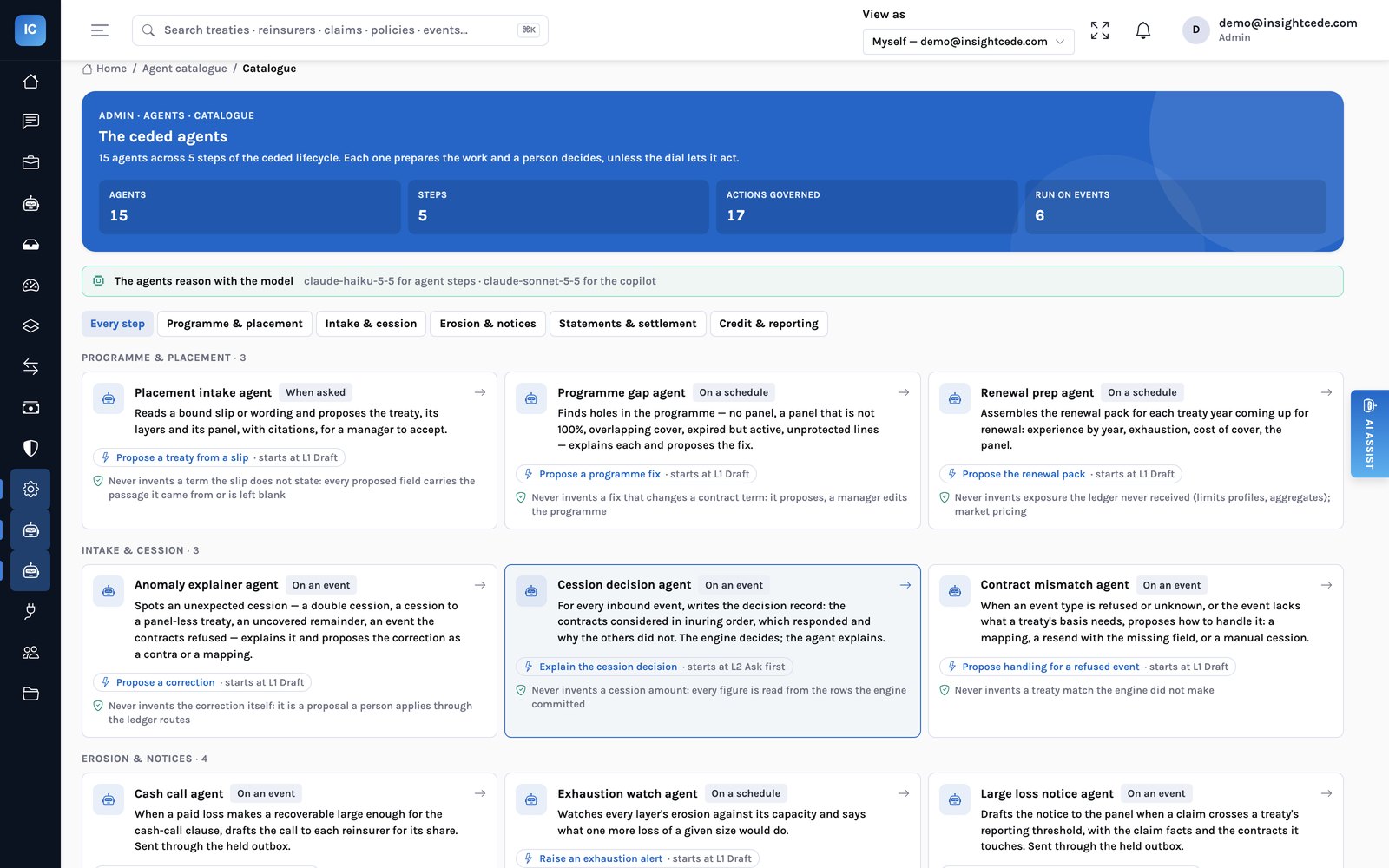
Each agent declares what it is grounded in and what it must never invent. A figure comes from a committed ledger row or it is not in the record; a contact comes from the reinsurer master or the draft has no addressee; a term comes from the slip’s text with the passage cited, or the field stays blank.
| Step | Agent | Prepares | Default level |
|---|---|---|---|
| Programme & placement | Renewal prep | The renewal pack for each expiring treaty year | L1 Draft |
| Placement intake | A treaty, its layers and its panel from a slip — every field citing its passage | L1 Draft | |
| Programme gap | The gaps (no panel, panel ≠ 100%, overlap, expired-but-active, unprotected lines) and the fix | L1 Draft | |
| Intake & cession | Cession decision | The explanation of every inbound event: contracts in inuring order, which responded and why not | L2 Ask first |
| Anomaly explainer | The correction for a double, panel-less, uncovered or refused cession | L1 Draft | |
| Contract mismatch | The handling of an event that did not fit: mapping, resend or manual | L1 Draft | |
| Erosion & notices | Large loss notice | The notice to the panel when a claim crosses the threshold — held | L2 Ask first |
| Cash call | The call for each reinsurer’s share of a paid loss — held | L2 Ask first | |
| Reinstatement | The reinstatement premium notice, checked against reinstatements remaining — held | L2 Ask first | |
| Exhaustion watch | The alert on a layer near exhaustion, with scenarios | L1 Draft | |
| Statements & settlement | Statement | The period-close checklist; strike the bordereaux; send the statements | L2 Ask first |
| Collections | The chaser per reinsurer by age (held); escalation; dispute capture | L2 / L1 | |
| Reconciliation | Offsets and differences against a reinsurer’s statement | L1 Draft | |
| Credit & reporting | Counterparty watch | Collateral or limit proposals from ratings, concentration and Pulse signals | L1 Draft |
| Schedule F | The draft parts and what is missing | L1 Draft |
Agents prepare, people decide
Every piece of work arrives as a decision you can answer
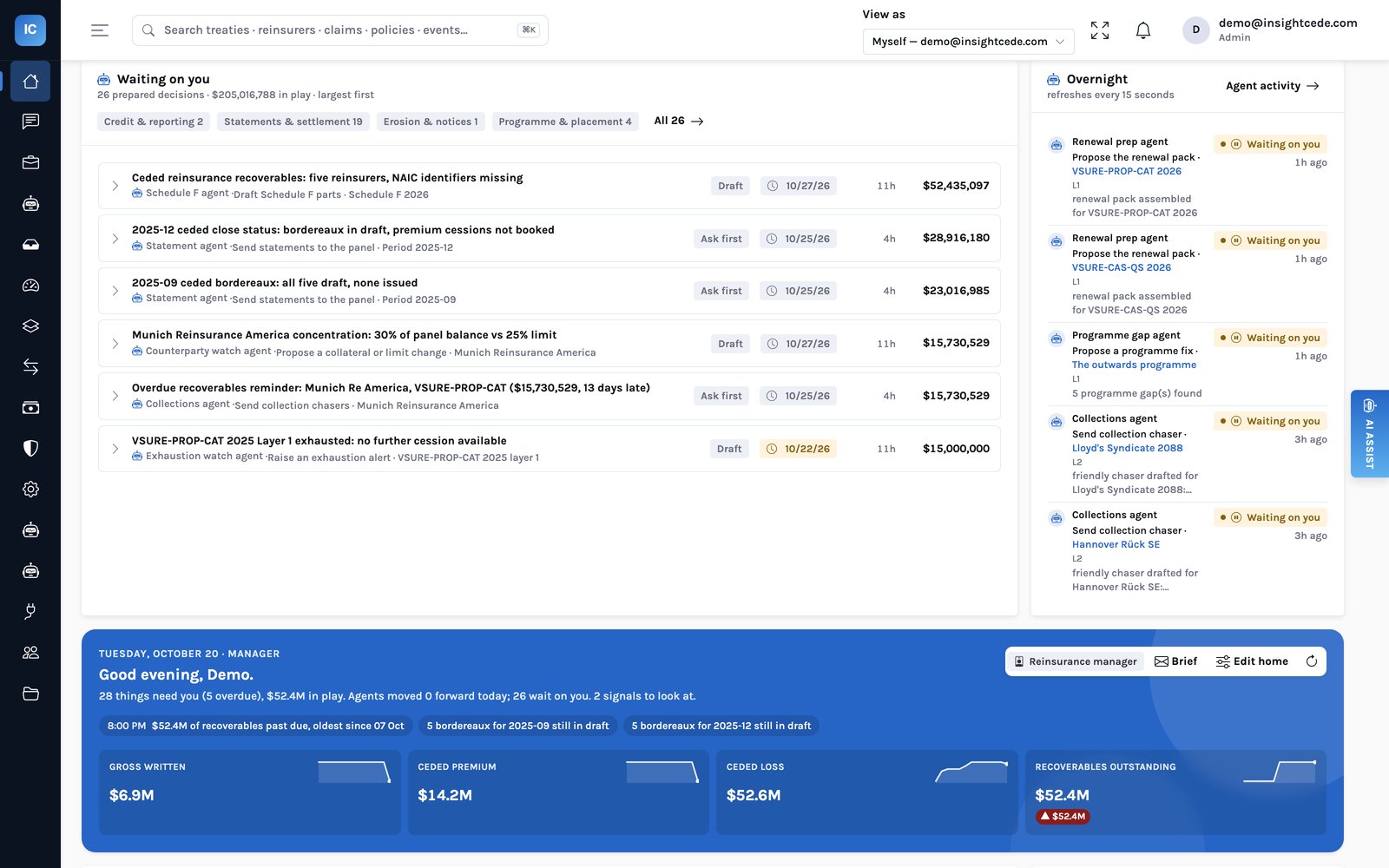
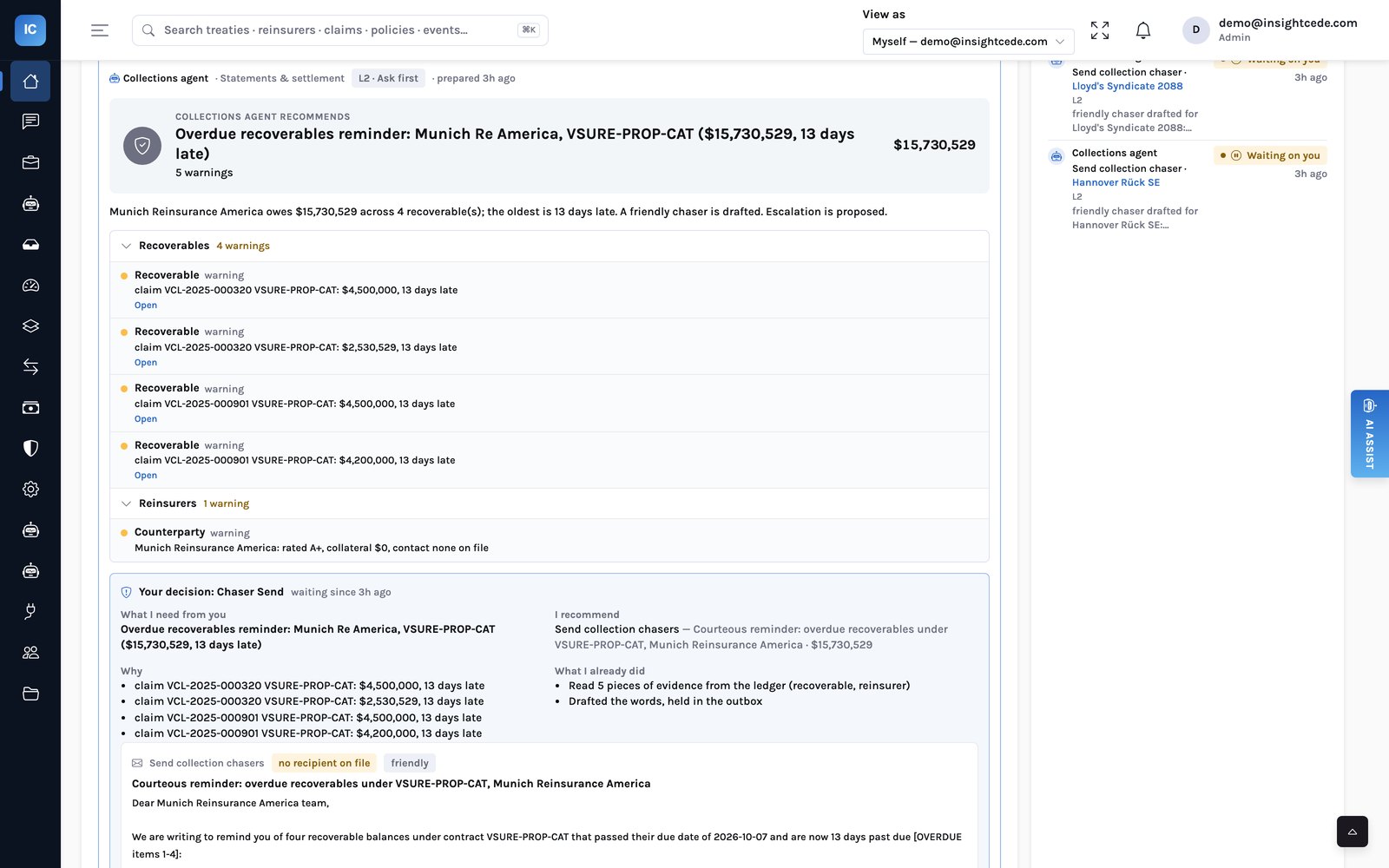
An agent never writes a cession, a recoverable or a bordereau. It writes a decision record: the subject, the money at stake, the evidence with the ledger table each figure came from, what accepting does, and — when the proposal is a message — the message itself, held in the outbox.
The queue, money first
Home opens on what the agents prepared and are waiting on you for, ordered by money then age, grouped by step. Each row opens its decision in place.
Evidence, not assertion
Every figure in a decision carries the table it was read from and a link into the ledger. When the model could not be reached, the record says so and the evidence stands on its own.
Held sends
A chaser, a notice, a cash call or a statement is written held. It leaves only when a person accepts — and outside production every send is a dry run.
A dial that moves on evidence
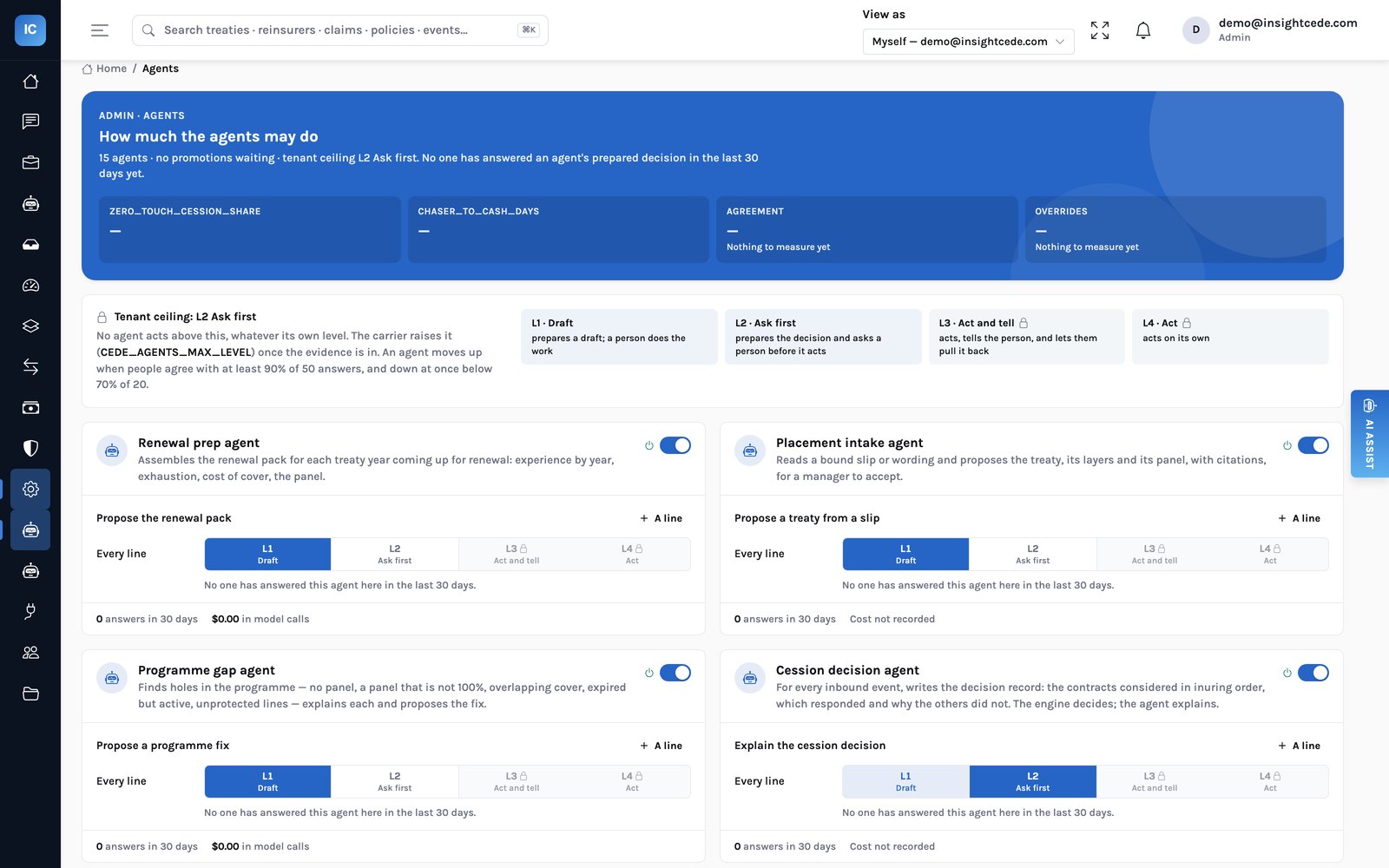
L1 Draft, L2 Ask first, L3 Act and tell with a pull-back window, L4 Act. Promotion is recommended at 90% agreement over 50 answers and accepted by a manager; demotion below 70% is immediate.
A kill switch
One switch drops an agent to Draft on every action and line, at once, audited. The tenant ceiling — Ask first by default — caps every agent whatever its record.
Every run is a record
The identity it ran as, the level and what limited it, the prompt version, the model, tokens, cost and trace — and every row it touched is stamped as the agent.
Net belongs to one system
Cede owns net. Everyone else reads it.
A cession is triggered by a policy transaction or a claim transaction, so it belongs inside neither the policy system nor the claims system. InsightCede sits beside them, derives net premium, net incurred and the ceded loss ratio, and publishes them as a read. It never writes back — the moment two systems both claim to own net, they disagree.
InsightUW reports policy transactions
Bound, endorsed, audited, cancelled, reinstated — each carrying the premium delta the transaction added, never the balance, so a policy is never re-ceded on every change.
InsightCW reports claim transactions
Reserve movements, payments, recoveries and cat events — each carrying the claim’s ground-up position after the event, because an excess layer attaches on the size of the loss.
The data API publishes net
Three governed contracts: net_position gross to net by treaty year, claim_net a claim net of reinsurance, recoverable_aging what each reinsurer owes and how late.
Pulse reads it, and supplies the news
InsightPulse reads the position like any other consumer. In the other direction Cede pulls Pulse’s news on the panel and the treaty brokers each day — which the counterparty and collections agents cite, and never turn into a fact.
The engine is the calculator
Three rules enforced, not assumed
The agents decide what to do about what the engine computed, and explain it. The engine decides which contracts respond, in what order, and how much — append-only, idempotent, and with a note on every outcome, including “nothing ceded”.
Capacity
A layer cannot pay more than it has
Limit, plus the limit again per available reinstatement, and no more. What it cannot absorb is written to the cession as uncovered, with a reason — a retained loss shows as a retained loss.
- Risks-attaching or losses-occurring matched from the contract
- Inuring order read, never assumed
- Uncovered amounts carried with their reason
Cost
Reinstatements are finite and cost money
Eroding a layer consumes capacity and raises a reinstatement premium payable by the carrier, pro rata from the loss date — and only while a reinstatement remains.
- Reinstatement premium raised by the engine
- Counted against reinstatements remaining
- A programme that tracks erosion but not cost reports free cover
Ledger
Erosion is derived, never stored
Erosion and reinstatements used are recomputed from the cession ledger. A correction is a contra entry, never an edit, because the period it landed in has already been reported.
- Append-only premium and loss ledgers
- Contra rows, not edits
- Money in decimal, never floating point
See it in action
The workbench your ceded desk works in
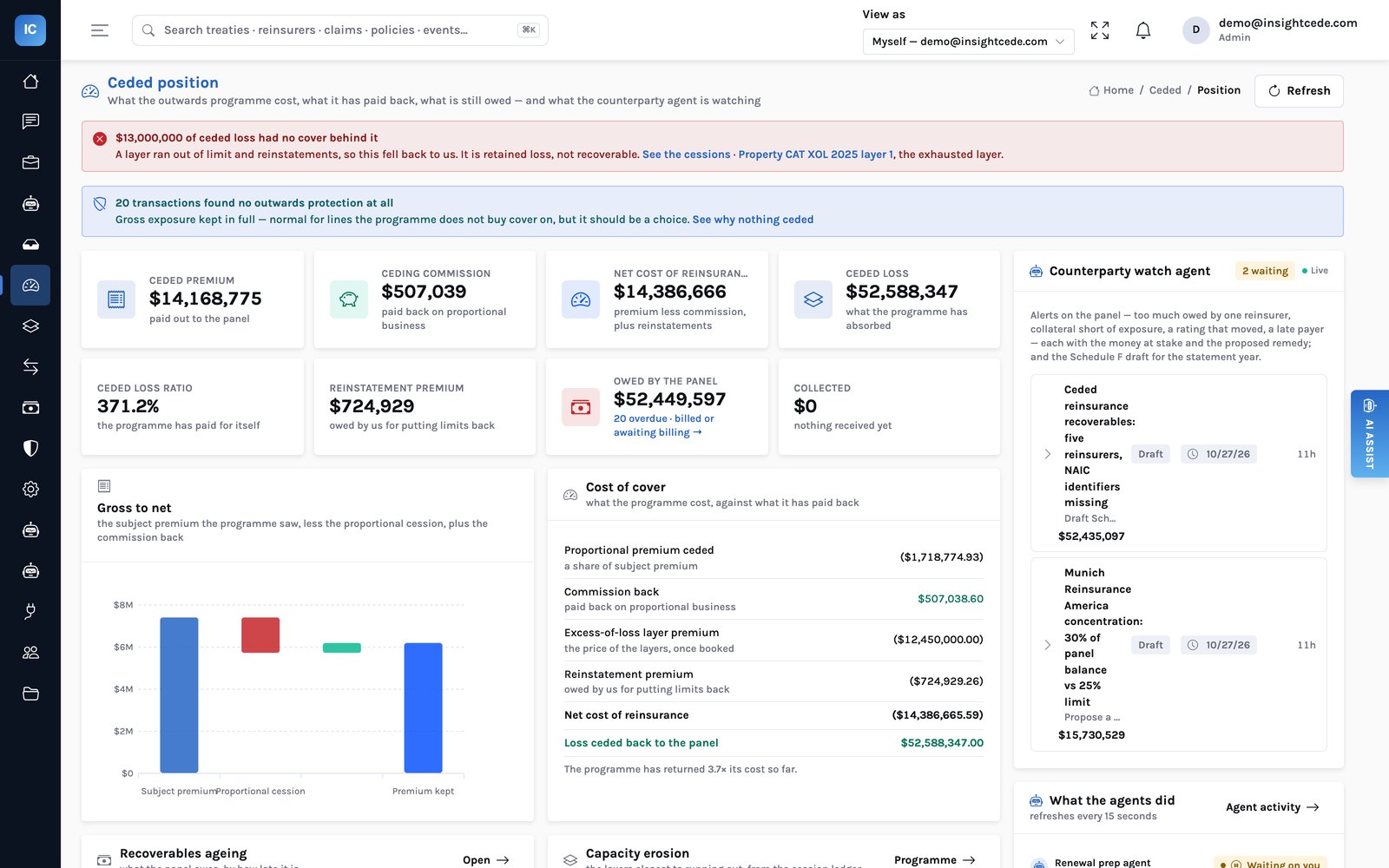
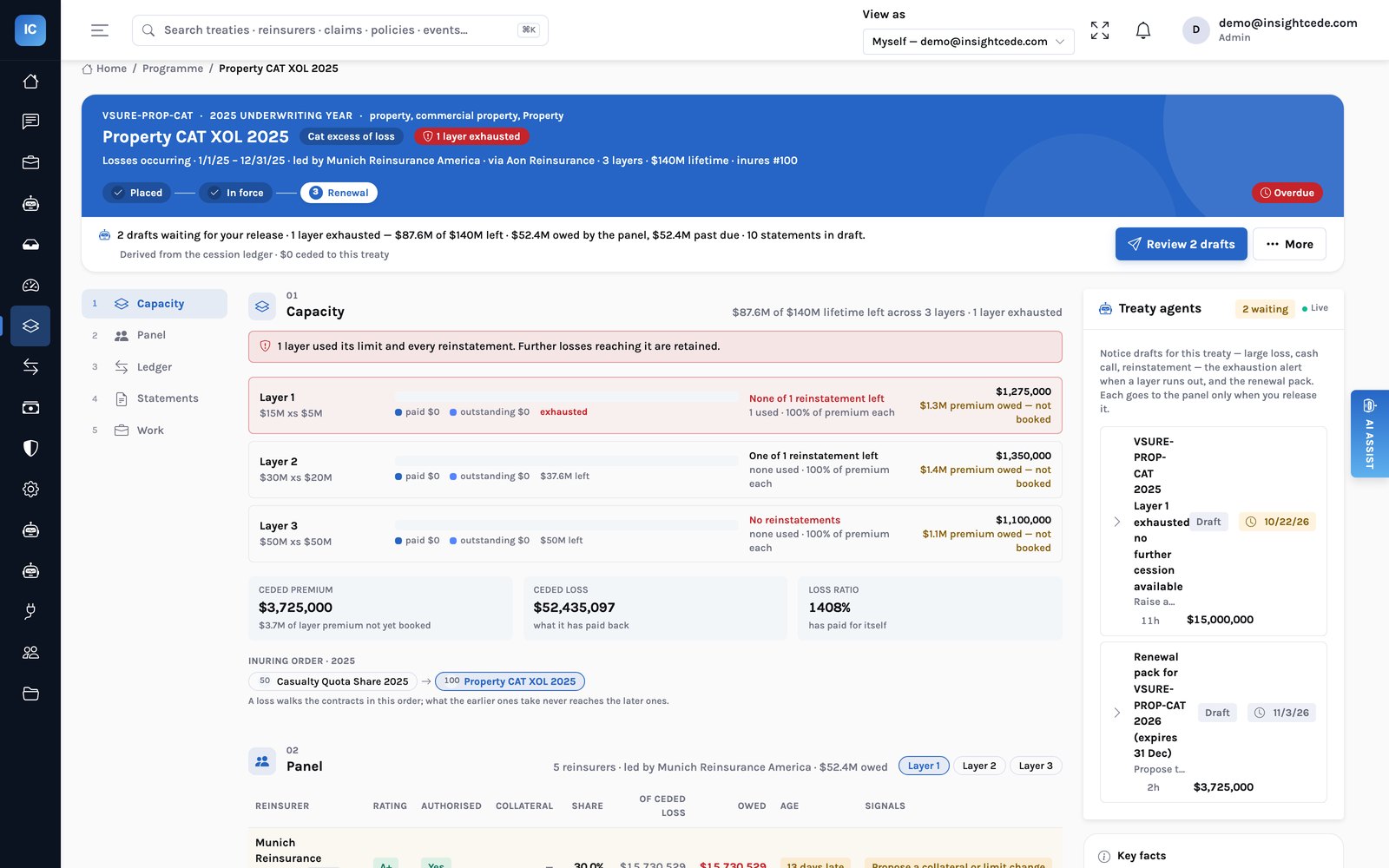
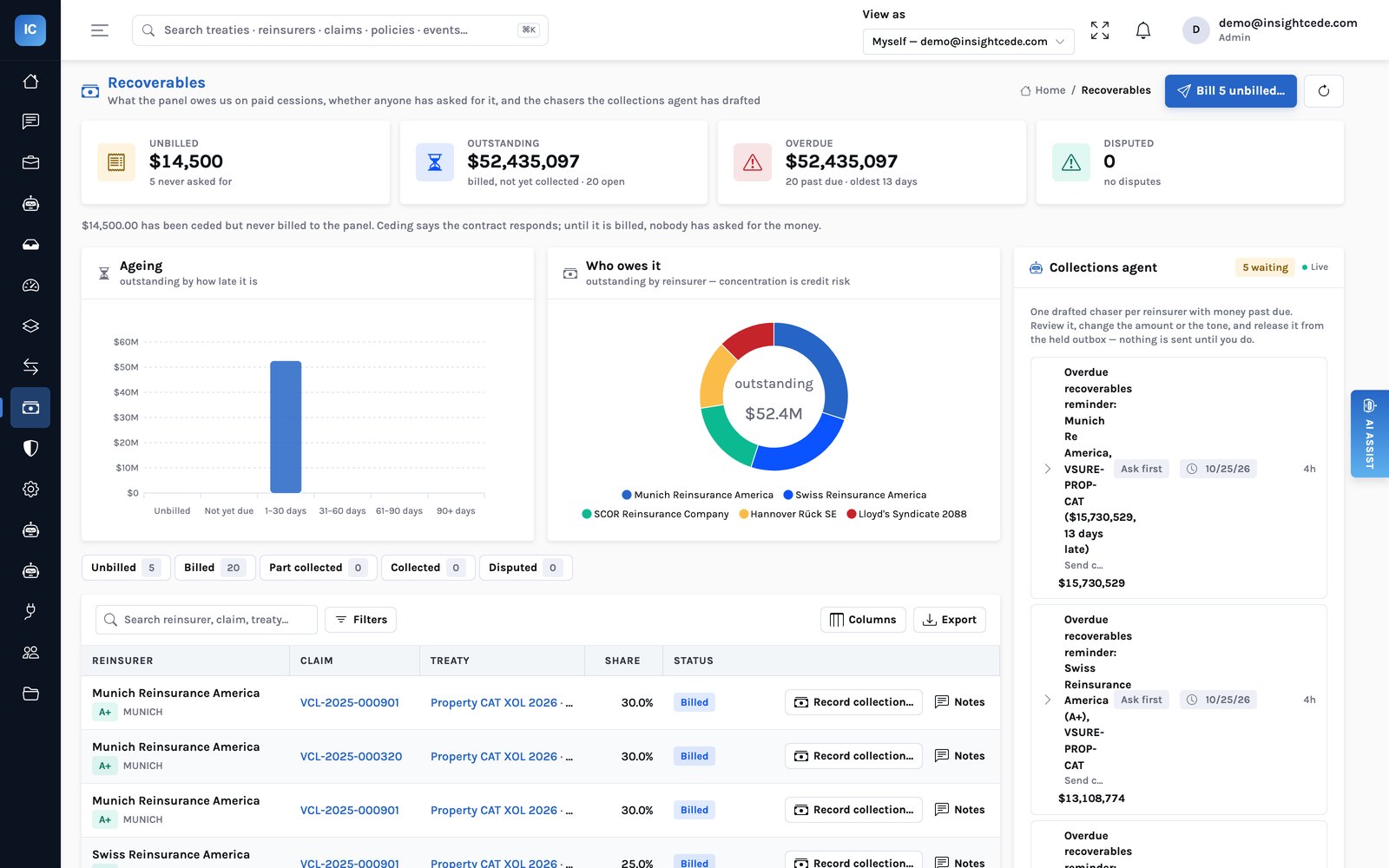
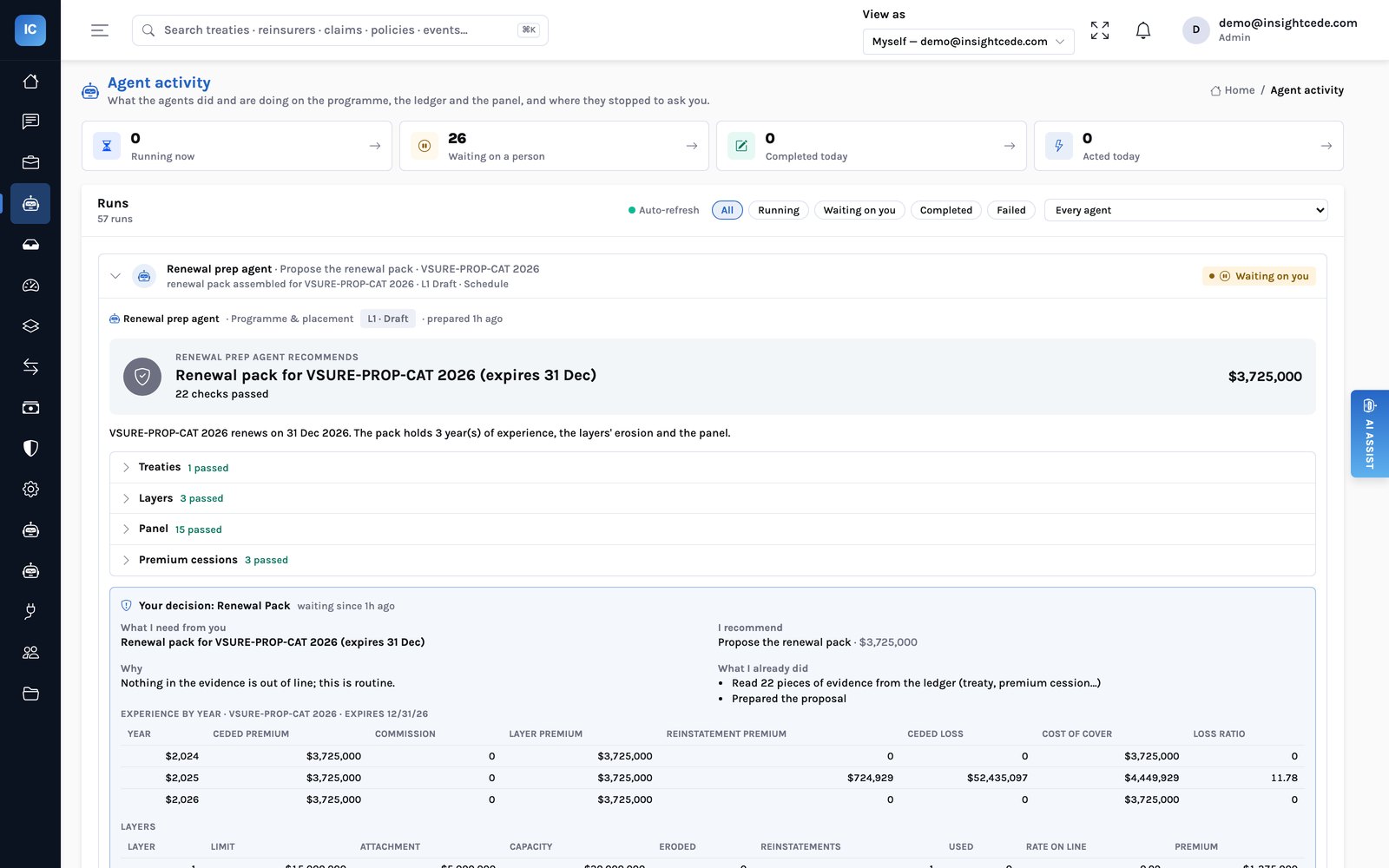
Captured from the live demo programme of a US property and casualty carrier — demo data, not a customer.
From the blog
Notes from the ceded desk
Use cases across the lifecycle, how the product decides what it decides, and what it does not do.
Use case
One hurricane, six answers
A cat loss arrives from claims. By the time the panel pays, it has been told, billed, reinstated, stated and chased — and every step a person took was an answer to something already prepared.
Read article
How it works
Agents prepare, people decide
Every agent action has a level on a dial. It moves only on evidence — agreement over many answers — and a kill switch drops it to Draft at once.
Read article
How it works
Net belongs to one system
The moment two systems both claim to own net, they disagree. Cede owns it; underwriting, claims and Pulse read it through the data API, and Cede never writes back.
Read article