The claims team pays $3 million on a warehouse fire on the twentieth of May. The per-risk treaty will pay back $2 million of it. On the ordinary path that $2 million appears on the May account, which is struck after the month closes, sent in the first week of June and settled on the treaty’s terms some weeks later. For two months the carrier funds the reinsurers’ share of a loss it has already paid.
The cash loss clause is there to shorten that: above a stated amount, the cedant may call the reinsurers’ share of a paid loss at once. Desks that know the clause still use it late, because someone has to notice that a payment crossed the line, work out each share and write the call. That noticing is what the cash call agent does.
Only paid loss is called
The money in a cash call comes from the engine, not the agent. When InsightCW reports a payment, the engine cedes the change in the claim’s paid position to every contract that responds and turns each paid cession into recoverables, one per reinsurer on the layer’s panel, split by signed line and rounded to the cent with the residual cent on the lead, so the parts always add back to the cession. An outstanding cession says the contract will respond; it does not entitle the carrier to ask for money yet, and the engine does not raise a recoverable for it. Billing on reserves is how a ceded ledger and a reinsurer’s ledger stop agreeing.
The agent runs after the engine commits, on three kinds of claim event: a payment, a recovery and a close. It reads every recoverable on the claim that is unbilled or billed and still outstanding, adds them up per reinsurer, and compares the total with the carrier’s cash-call threshold — $250,000 unless configured otherwise. Below it, nothing is prepared. At or above it, the agent drafts the call.
flowchart LR
    A["Payment event
from InsightCW"] --> B["Engine cedes
the paid change"]
    B --> C["Recoverables
split by share, to the cent"]
    C --> D{"Outstanding on
the claim over
the threshold?"}
    D -- no --> X["Nothing prepared"]
    D -- yes --> E["Cash call drafted
each share listed
held at L2"]
    E --> F{"Analyst"}
    F -- accept --> G["Released to the
contacts on file"]
    F -- reject --> H["Cancelled
reason recorded"]
    G --> I["Analyst bills
due in 30 days"]
What the call contains
The draft lists each reinsurer’s share by legal name and amount, and the claim it arises from. The evidence under it is one line per recoverable — reinsurer, treaty, amount, status, each linked to the claim’s recoverables — and one more line that says where the threshold came from: the carrier’s configuration, not a clause. The proposal carries the shares as figures, so what a person accepts can be checked line by line against the ledger.
It is one message, addressed to the contact on file for each reinsurer owed, listing every share.
It is written into the outbox held. The checkpoint, cash_call_send, starts at
L2: the analyst accepts and the message is released; rejects and it is cancelled. Outside
production the release goes to a dry-run provider and nothing leaves.
Three things to check before accepting
The record is built so that the check takes a minute, not an afternoon. First, the recoverable lines against the paid cession they came from: each links to the claim’s recoverables, and the shares add back to the cession to the cent, the odd cent on the lead. Second, the status on each line: unbilled is new money, billed is money already asked for, and a call that includes a billed line is asking twice. Third, the address line: only reinsurers with a contact on file are on it, and the draft does not say who is missing, so compare it with the panel.
A recovery — salvage, subrogation, a voided cheque — runs the other way. The engine writes a negative paid cession and a credit recoverable against each reinsurer, which goes on the next bill so the bill nets. The cash call agent leaves credits out of its total; it only ever calls money owed to the carrier.
The time it saves
The gain is not in the drafting; a cash call is a short letter. It is in when the call goes. A payment on the twentieth of a month waits, on the statement route, for the month to end, for the bordereaux to be struck and sent, and then for the treaty’s settlement terms. On the cash call route it is drafted the moment the payment is ceded and goes when a person accepts it.
gantt
    dateFormat YYYY-MM-DD
    axisFormat %d %b
    section Statement route
    May runs to its end :a1, 2026-05-20, 2026-05-31
    Strike and send :a2, 2026-06-01, 3d
    Settlement terms, 30 days :a3, 2026-06-04, 30d
    section Cash call
    Drafted and accepted :b1, 2026-05-20, 2d
    Billed, due in 30 days :b2, 2026-05-21, 30d
The use case, in one table
| A paid loss, called from the panel | |
|---|---|
| Trigger | A claim.payment_issued, claim.recovery_received or claim.closed event, after the engine commits, when the claim’s outstanding recoverables reach the threshold |
| Actor(s) | The ceded reinsurance analyst |
| Agent | Cash call agent |
| Grounded in | The recoverables on the claim (unbilled or billed, outstanding, due); the reinsurer records and their contacts; the configured threshold |
| Prepares | A cash call listing each reinsurer’s share, held in the outbox |
| Checkpoint & default level | cash_call_send · L2 Ask first |
| What a person decides | Whether the call goes as drafted; when to bill the recoverables, which sets the due date |
| What is recorded | The decision record with each recoverable and the threshold as evidence; the shares in the proposal; the outbox row held, released or cancelled; the answer as feedback |
Who owes it, at a glance
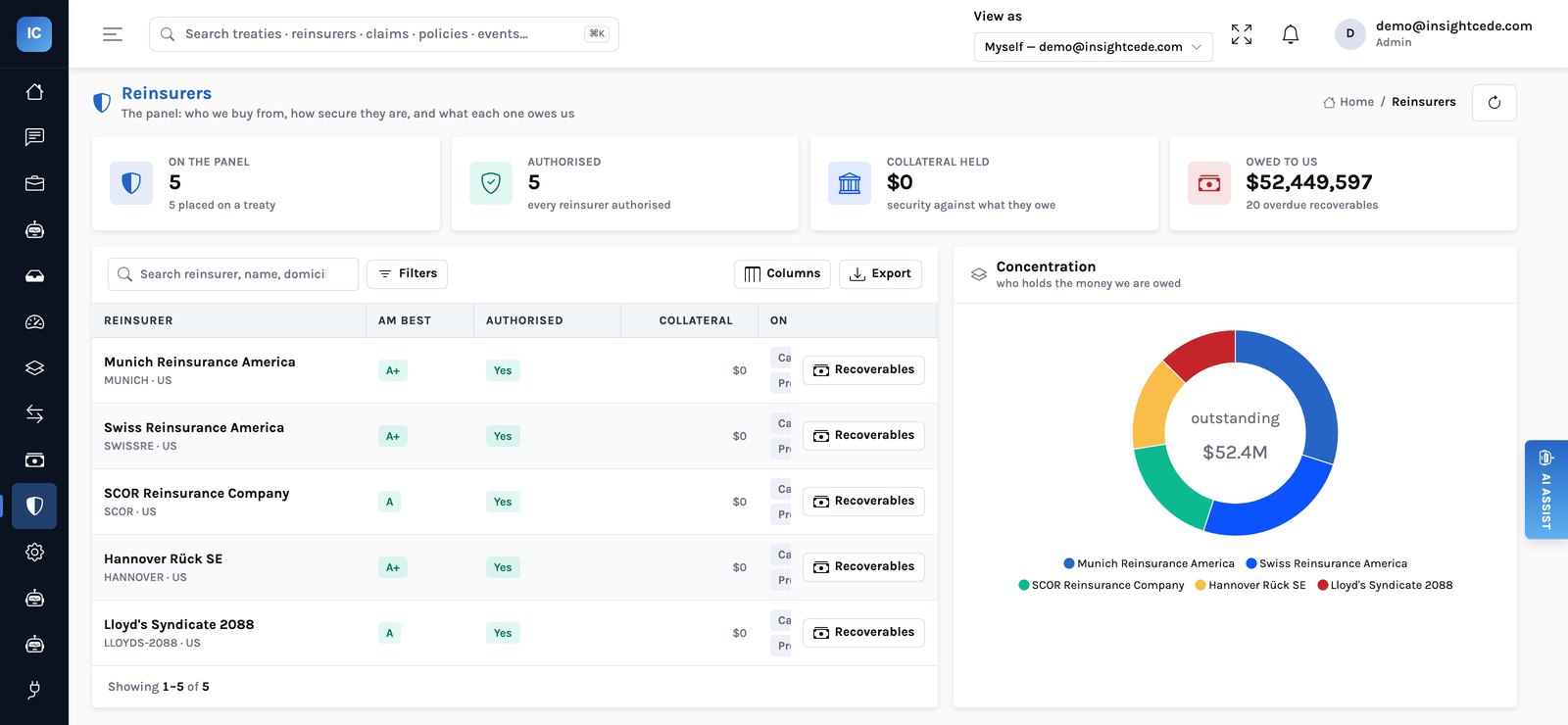
The reinsurer screen is the other half of the picture: each panel member with its rating, whether it is authorised and the collateral held, and a chart of who holds the money owed; opened on one reinsurer, it shows the collections agent’s drafted chaser and the counterparty watch beside it. A cash call that is accepted and billed shows up here as an amount owed with a due date; one that is not paid becomes the collections agent’s work on the first day it is late.
Why the threshold is configuration
A cash loss clause states its own figure, and it differs by treaty. Until treaty wordings are stored against the treaty year, the product does not know the clause, so the threshold is one carrier setting and the evidence says so. That is a deliberate limit on the agent: it is grounded in the configuration it was given and never invents a clause.
What it does not do
- It does not read the treaty’s clause. One threshold per carrier, $250,000 by default, applies to every treaty until wordings are stored.
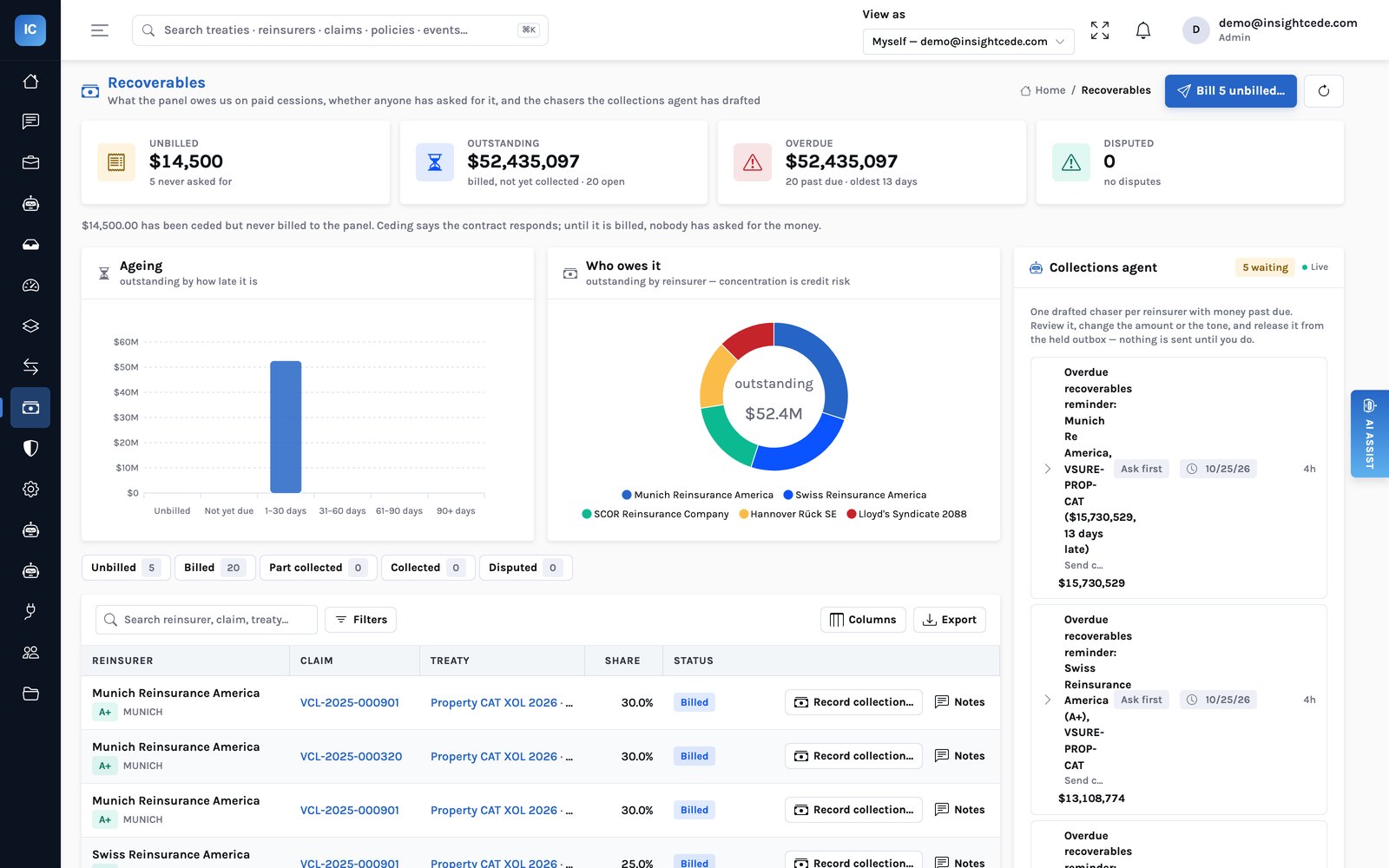
- It calls everything outstanding on the claim, not just the new payment. A billed but unpaid amount from an earlier call is in the next one, as in the June example. Read the recoverable lines before accepting.
- It does not bill. Accepting releases the message. The recoverables stay unbilled until a person bills them, and the 30-day due date runs from that moment, not from the call.
- It sends one message to the panel. Every share is listed in one letter to every contact on file, not a separate call to each reinsurer; a reinsurer with no contact is left off the address line.
- The statement does not net it off. The month’s bordereau is struck from the cessions, so the called paid loss appears on the account as well. Reconciling the call with the statement is the analyst’s.
- A Change is not re-sent. Edits to the wording or amount are recorded on the decision; the message released on accept is the agent’s draft.
If your cash calls go out with the quarterly account because nobody noticed the payment, show us last year’s large paid losses and we will show you when each call would have been drafted.