Nobody chose to have a third of the recoverables sitting with one reinsurer. It happened because that reinsurer wrote the largest line on the treaty that had the bad year. The security committee approved the panel at renewal, on ratings that were current then. Since then a loss has turned premium into money owed, and the question the committee answered in January — are these reinsurers good for it? — has a different shape in October: is this one reinsurer good for this much, and is anything we read about it changing that?
Most carriers answer that question when someone happens to ask it. The counterparty watch agent asks it every day.
The four concerns, and how each is measured
Once every twenty-four hours, in the credit step, the agent looks at each reinsurer on the panel and raises a decision for any that has at least one of four concerns:
| Concern | When it is raised | The remedy proposed |
|---|---|---|
| Concentration | The reinsurer holds 25% or more of everything the panel owes on recoverables (the limit is the carrier’s setting), and more than one reinsurer owes something | Cap new cessions to it, or place part of its line elsewhere at renewal |
| Rating | It owes money and its AM Best rating is A- or below, or there is no rating on file | Ask for collateral — a letter of credit or a trust — against the outstanding balance |
| Collateral | It is unauthorised and the collateral held is less than what it owes | Call for collateral equal to the shortfall |
| Signal | InsightPulse has supplied a news item on it in the last thirty days marked critical, high or warning, or whose title mentions a downgrade, a rating or a credit watch | Review the item with the broker; consider a limit |
Every concern is a figure from the ledger or a cited item, and the evidence says which: the concentration line carries the reinsurer’s balance and the panel total; a signal carries its date, its headline and a link to the article. The agent never invents a rating — an unrated reinsurer stays unrated and is raised as such — and a news item is cited, not paraphrased into a fact. The model, where it is reachable, writes the explanation and may rewrite the steps; the concerns themselves are decided before it is asked.
Where the news comes from
Cede does not read the news. InsightPulse does, and Cede asks it. Once a day a background sync lists every reinsurer on the panel and every treaty broker, asks Pulse to resolve the names it has not linked yet to companies Pulse tracks (a link below 60% confidence is not made, and a miss is retried after a week), then pulls the recent news for the linked companies into Cede, each item with its publisher, date, category, severity and link. The sync is idle unless the carrier has pointed Cede at a Pulse server; it shows as a flow on the integrations hub.
sequenceDiagram
    participant C as Cede ledger
    participant P as InsightPulse
    participant A as Watch agent
    participant H as Head of reinsurance
    C->>P: resolve panel and broker names
    P-->>C: links, with confidence
    C->>P: news for linked companies
    P-->>C: items with severity and link
    A->>C: balances, ratings, collateral, news
    A->>H: one decision per concern-holder
    H->>H: Accept, Change, Reject or Ask
    Note right of H: remedy agreed with the broker
Use case details
| Counterparty watch | |
|---|---|
| Trigger | Scheduled, every 24 hours (the credit step), for each reinsurer with at least one concern |
| Actor(s) | Head of reinsurance; the CRO and CFO for a remedy that changes the panel or calls collateral; the broker |
| Agent | counterparty_watch_agent, action credit_proposal |
| Grounded in | cede_reinsurer (ratings, collateral held, authorised), cede_recoverable (what each owes), cede_external_signal (Pulse news), the concentration limit |
| Prepares | The concerns with their figures and citations, and the proposed steps: collateral, a limit, a placement change at renewal, a broker conversation |
| Checkpoint & default level | credit_review at L1 Draft |
| What a person decides | Whether the concern is real or structural, which remedy, who approves it, and what to say to the broker |
| What is recorded | The run, the decision with every concern as evidence, the answer and any change as feedback |
The demo programme: a concentration that is really a line
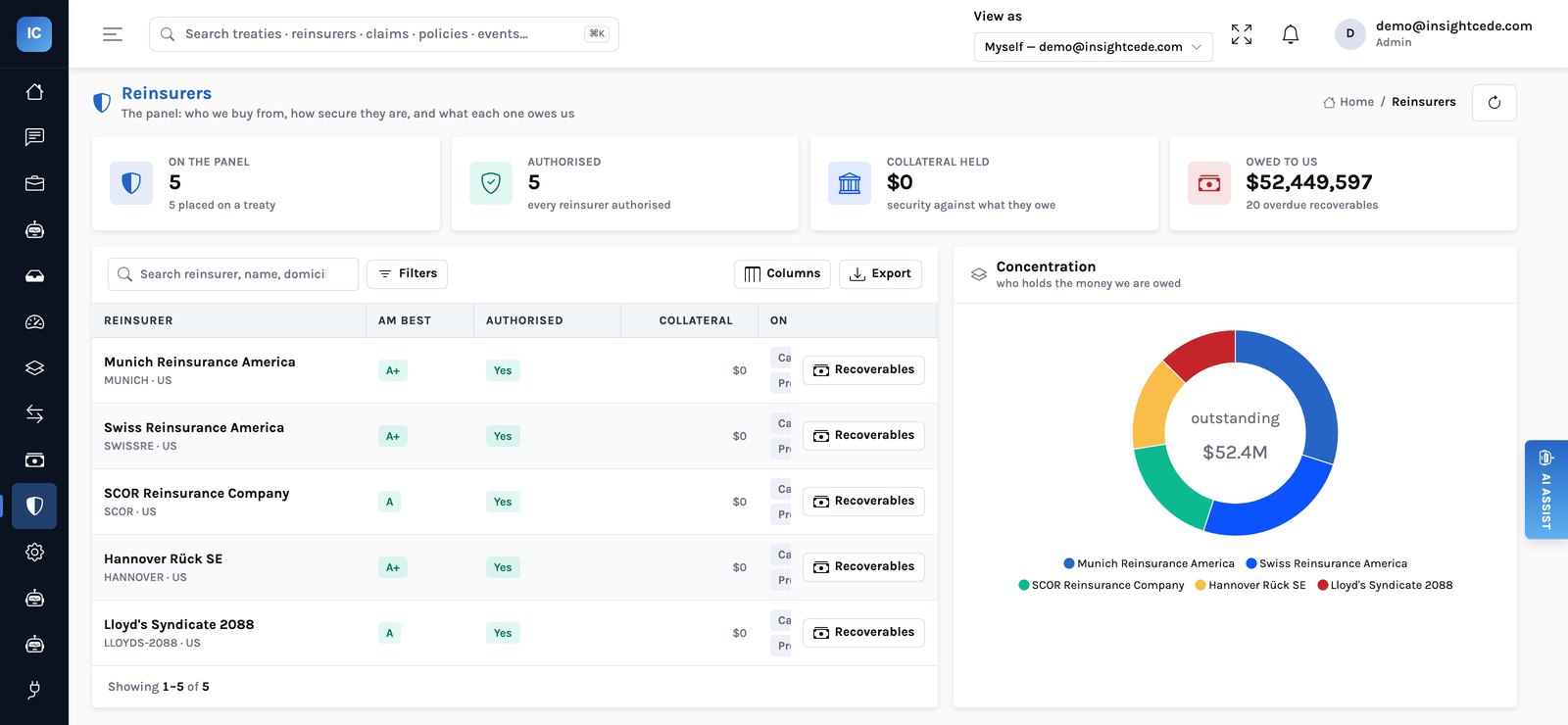
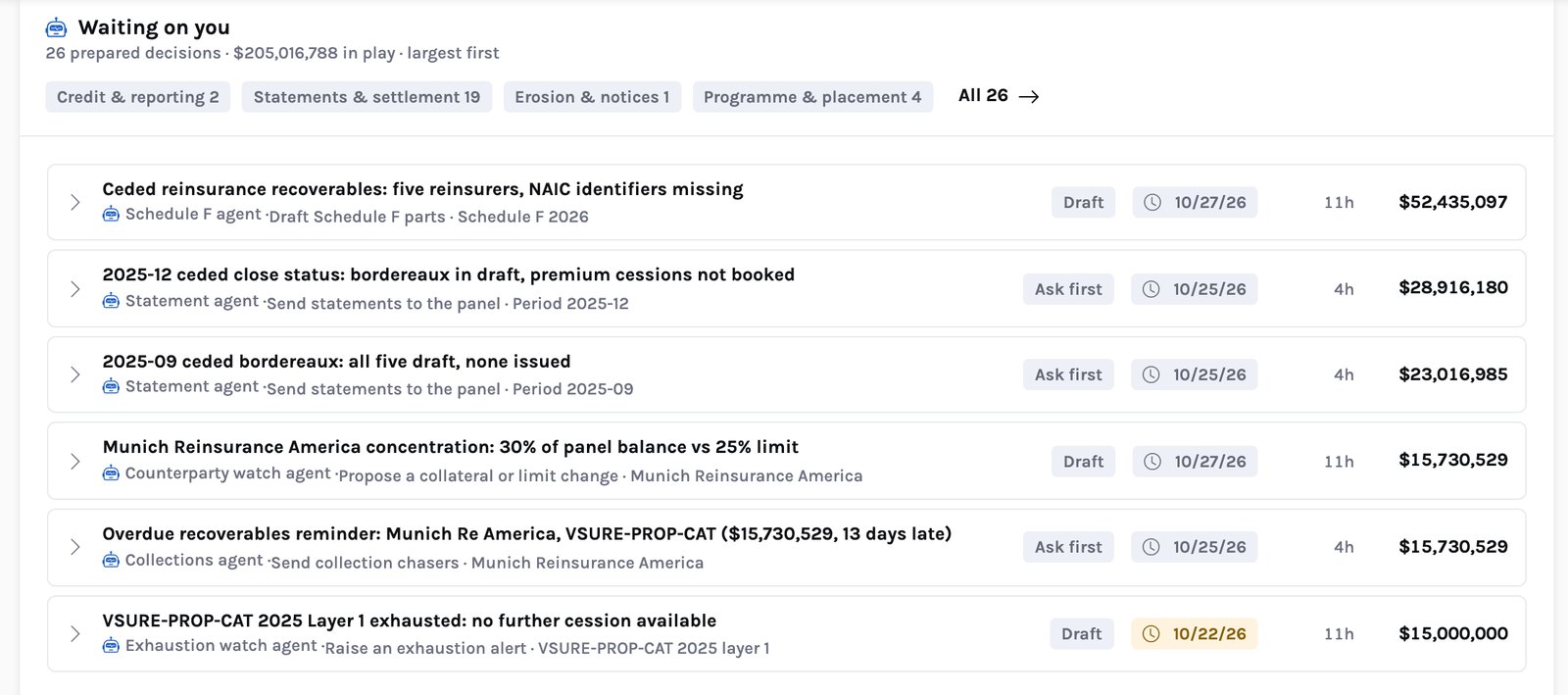
In the demo ledger the panel owes $52,435,097 on billed recoverables, all from two 2025 losses on one property catastrophe treaty. The counterparty watch agent has one decision waiting: the reinsurer with the 30% lead line holds $15,730,529 of it, which is 30% of the panel balance against a 25% limit. Its explanation works the limit out — 25% is $13,108,774, so the excess is about $2.6M — notes the A+ rating, that the reinsurer is authorised and holds no collateral, that no S&P rating is on file, and that the evidence has no clause or cure period for a limit breach, so none is stated. The demo has no Pulse items linked in the last thirty days, so the decision is on concentration alone.
pie showData
    title What the demo panel owes, by line ($M)
    "30% lead line" : 15.73
    "25% line" : 13.11
    "17.5% line" : 9.18
    "15% line" : 7.87
    "12.5% line" : 6.55
Look at the chart and the concern changes shape. The concentration is not drift: it is the panel as it was placed, applied to the one treaty that produced losses. The agent cannot tell a structural concentration from a reinsurer quietly becoming the only one paying slowly; a person can, in about a minute. That is why the record is at L1 and the remedy is a proposal — the right answer here is probably a smaller lead line at the next renewal, not a collateral call on an A+ reinsurer in the middle of a treaty year.
Three of the four concerns were mechanical to find and one remedy was mechanical to choose. The other remedy — whether to keep a reinsurer under review on the panel — needed a CRO, a broker and a renewal date, which is where the agent stops.
What it does not do
- It measures exposure on paid recoverables only. What a reinsurer owes is what has been billed or raised on paid losses. Its share of ceded case reserves, unearned premium and the limits it has written are not in the measure, so a reinsurer carrying a large reserved claim and nothing yet paid is not concentrated by this test.
- One limit for everyone. The concentration limit is a single carrier setting; a per-reinsurer limit approved by the security committee is not modelled.
- Ratings are what the master says. The rating test reads the AM Best field; an S&P rating on file is shown to the model but not tested. Authorised is a yes or no — certified and reciprocal-jurisdiction status, with their reduced collateral, are not modelled.
- News is only as good as the link. A Pulse item reaches a reinsurer through a name match Pulse made with at least 60% confidence. A wrong link would cite news about the wrong company; the citation is there so a person can see that. Only the first qualifying item is raised as a concern, and nothing sends a CRO an alert from it today — it waits in the queue like any other decision.
- There is no “accepted risk”. A concern you have answered is raised again at the next daily run for as long as it is true, and an unanswered decision expires after seven days and is prepared afresh. A structural concentration you have decided to live with keeps coming back until the balance or the limit changes.
- Accepting changes nothing in the ledger. The remedy — a collateral call, a limit, a different line at renewal — happens with the broker and the reinsurer. Collateral held is updated in the reinsurer master the programme is loaded from, not on this screen.
Why a news item is cited and never summarised
A sentence like “the reinsurer is under financial pressure” is the kind a model writes easily and the kind a security committee should never act on without reading the source. The agent puts the headline, the date and the link in the evidence and lets the person read it. The words it may write are about the ledger.
If your security committee meets once a year and your recoverables move every week, talk to us about running the counterparty watch over a demo ledger built from your own panel.