Ask a ceded reinsurance analyst what fills the week and the answer is a list of small, consequential jobs. Tell the panel about the large loss before they hear it from the broker. Call the cash under the cash-call clause before the quarter. Bill the reinstatement premium the carrier owes. Chase the reinsurer that is thirty days late without souring the renewal. Agree their statement with ours. Close the month.
None of those jobs is hard. All of them start with assembling the facts — which reinsurer, what share, which claim, which due date, which contact — and that assembly is what the agents do. What is left for the analyst is reading what they assembled and deciding.
Monday morning: the queue
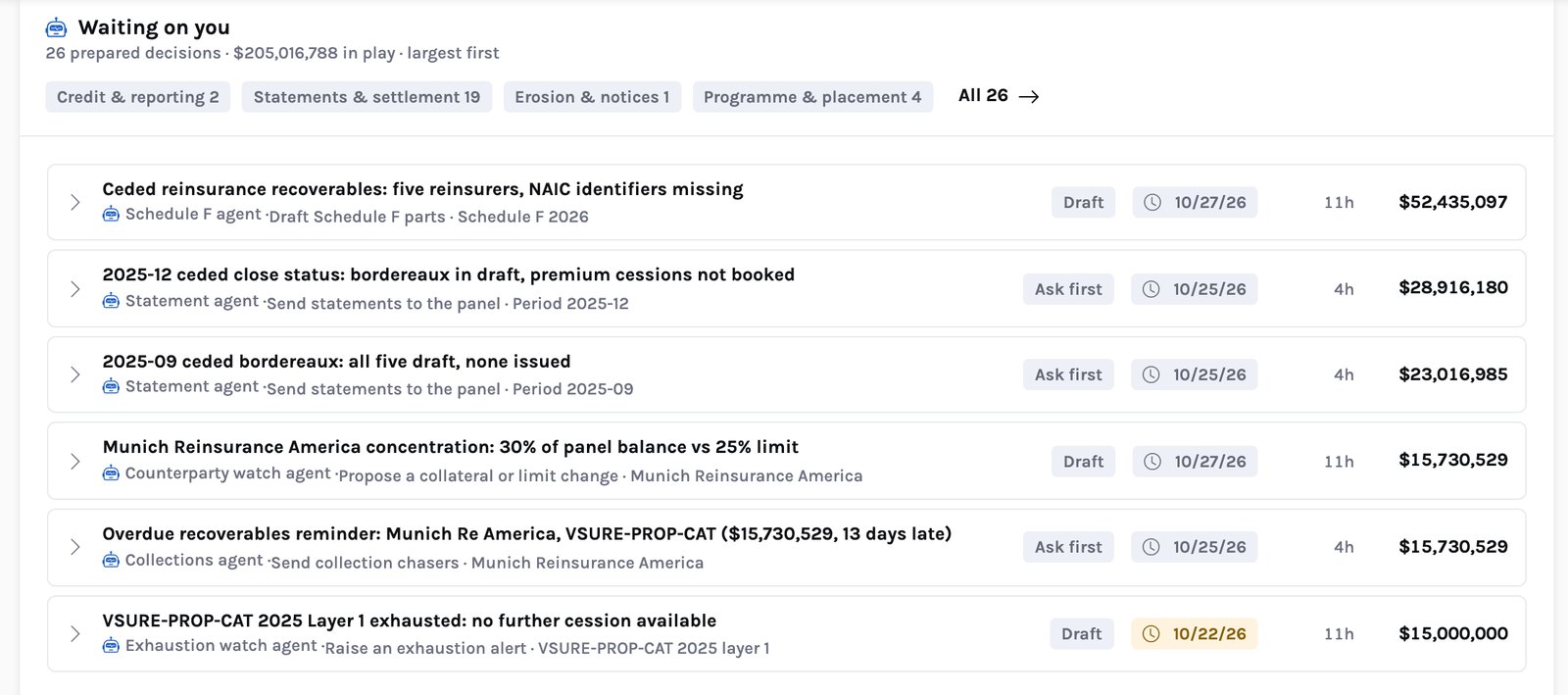
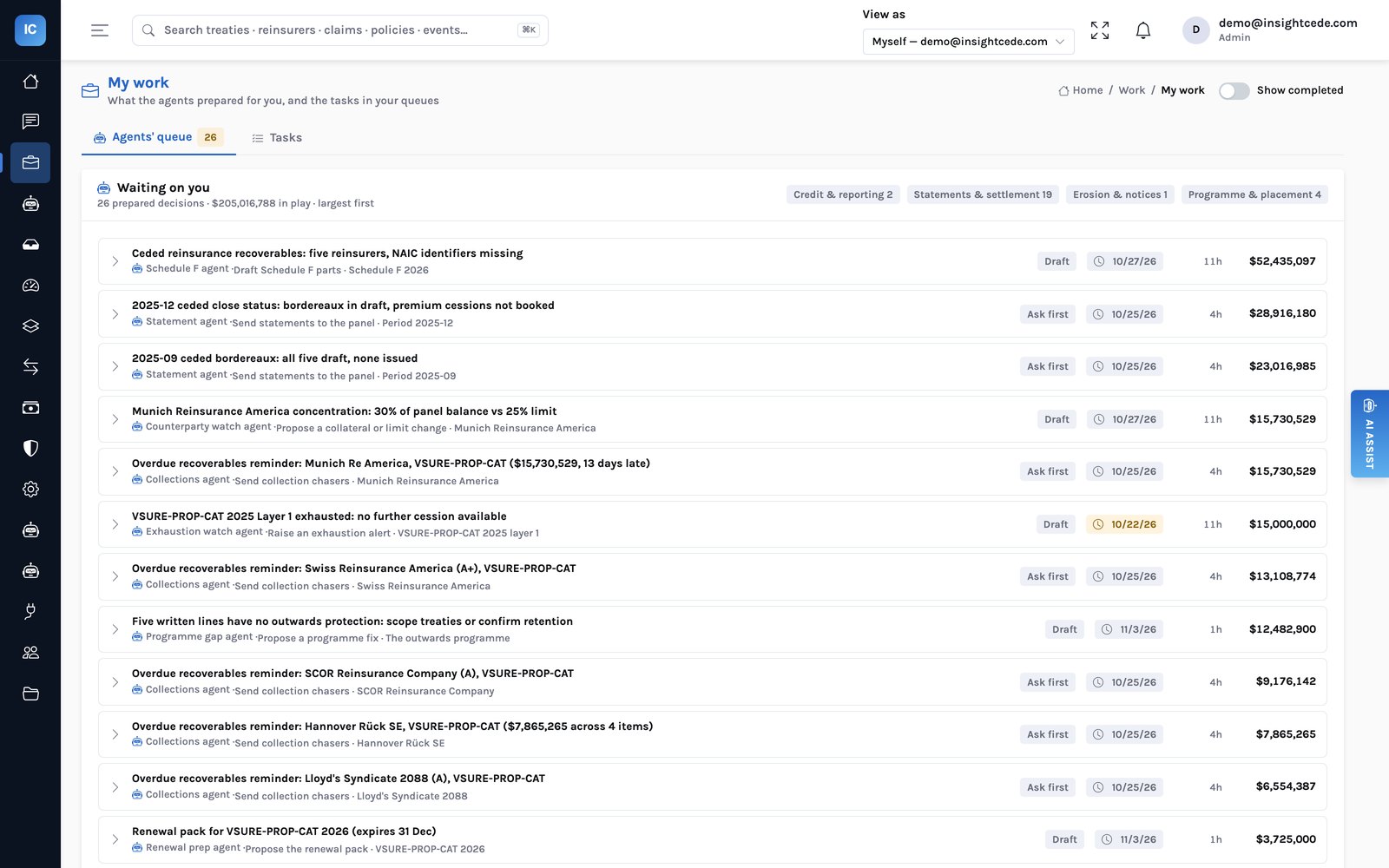
The first thing on Home is Waiting on you: every open decision the agents have prepared, ordered by the money at stake and then by how long it has waited. Each row shows the agent, the action, the subject, the level, the deadline, the age and the amount, and opens the full decision in place. My work carries the same queue as its first tab, then the tasks.
xychart-beta horizontal
    title "Open decisions in the demo queue, by lifecycle step"
    x-axis ["Settlement", "Programme", "Credit", "Erosion", "Cession"]
    y-axis "Prepared decisions" 0 --> 20
    bar [19, 4, 2, 1, 0]
That shape is typical of a desk between catastrophes: the volume is in settlement, the money is in a handful of erosion and credit items. In a loss week the erosion row fills up first, because notices, cash calls and reinstatement notices are prepared from the claim event the moment the engine has ceded it.
Nine answers from Ana in a week, and in each one the facts were already on the page: the shares, the threshold, the reinstatements left, the days late, the lines that did not match. The analyst's time went on the decisions, and on the two phone calls the agents named for her — the missing contact and the disputed item.
| Day | Agent | What it prepared | Level | Ana's answer | Counts as |
|---|---|---|---|---|---|
| Mon | large_loss_notice_agent | Notice to the panel, held | L2 | Accept | agreement |
| Mon | cash_call_agent | Cash call for 6,200,000, held | L2 | Change, then released | disagreement |
| Tue | reinstatement_agent | Reinstatement premium notice, held | L2 | Accept | agreement |
| Wed | collections_agent | Four chasers, firm | L2 | Accept × 4 | agreement × 4 |
| Wed | collections_agent | A fifth chaser | L2 | Change | disagreement |
| Thu | reconciliation_agent | Offsets and take-ups | L1 | Accept | agreement |
The two changes count against their agents. That is deliberate: the autonomy dial treats a softened sentence as a person disagreeing, so an agent whose drafts are routinely edited does not earn the right to send them unedited.
What to read before pressing Accept
Each kind of decision has one or two things worth checking, and the record puts them where they can be checked in seconds.
- A large-loss notice: the recipients, and the list of panel members with no contact on file. The notice goes to the first list; the second is the analyst's.
- A cash call: that the shares add up to the total and that the total is above the threshold shown in the evidence. The threshold is configuration, not a clause read from the wording, because wordings are not stored yet.
- A reinstatement notice: reinstatements used against reinstatements available. The agent raises a concern on the record when the check does not come out clean; the premium itself is the engine's figure, never the agent's.
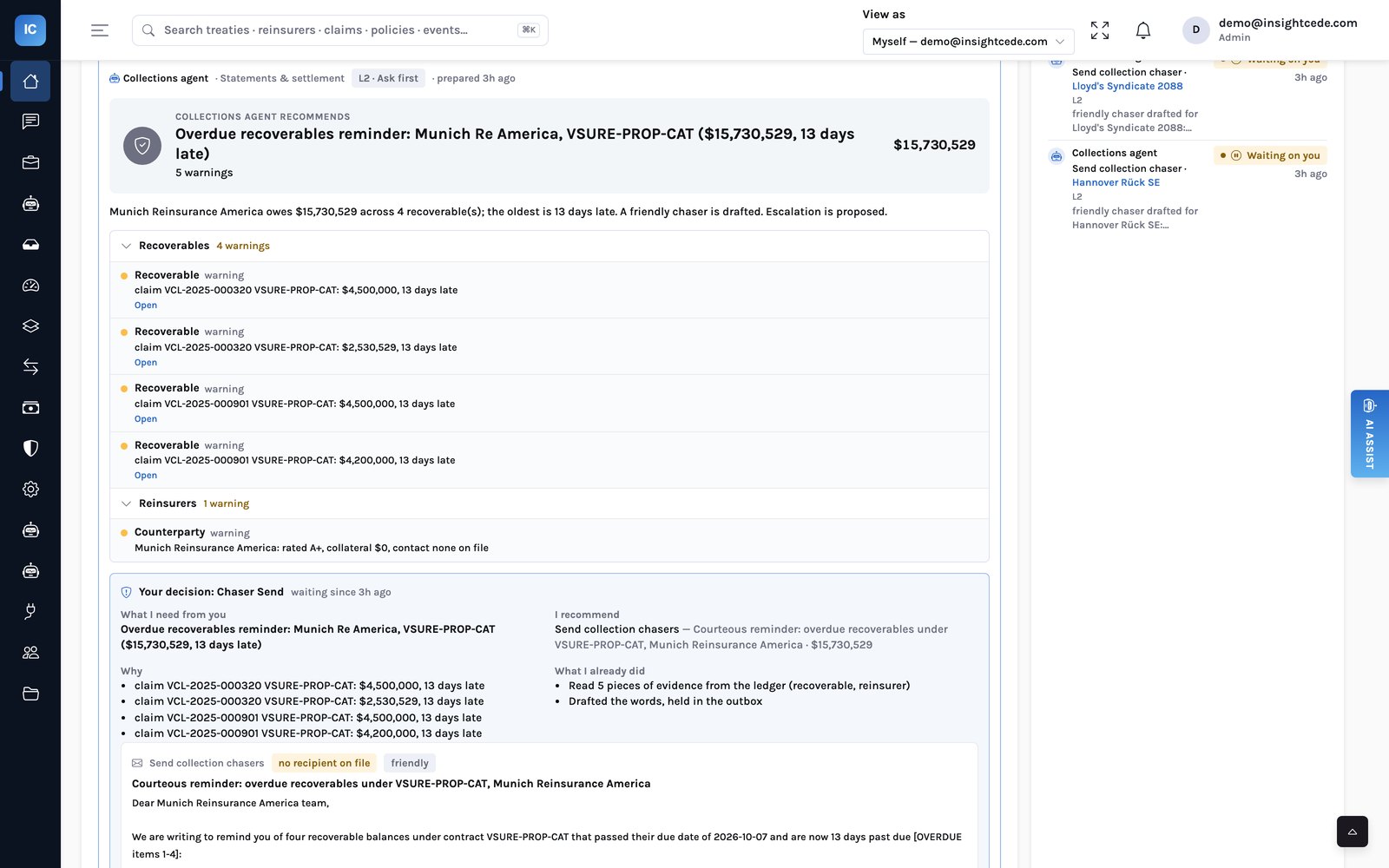
- A chaser: the tone against the age. Up to 30 days late the agent drafts a courteous reminder, up to 90 a firm request with the due dates, beyond that a final notice naming escalation. A disputed item always brings an escalation proposal with it.
- A statement: which periods and which reinsurers. Striking and sending are separate decisions, so a period can be struck and checked before anything is sent.
What stays in the analyst's hands
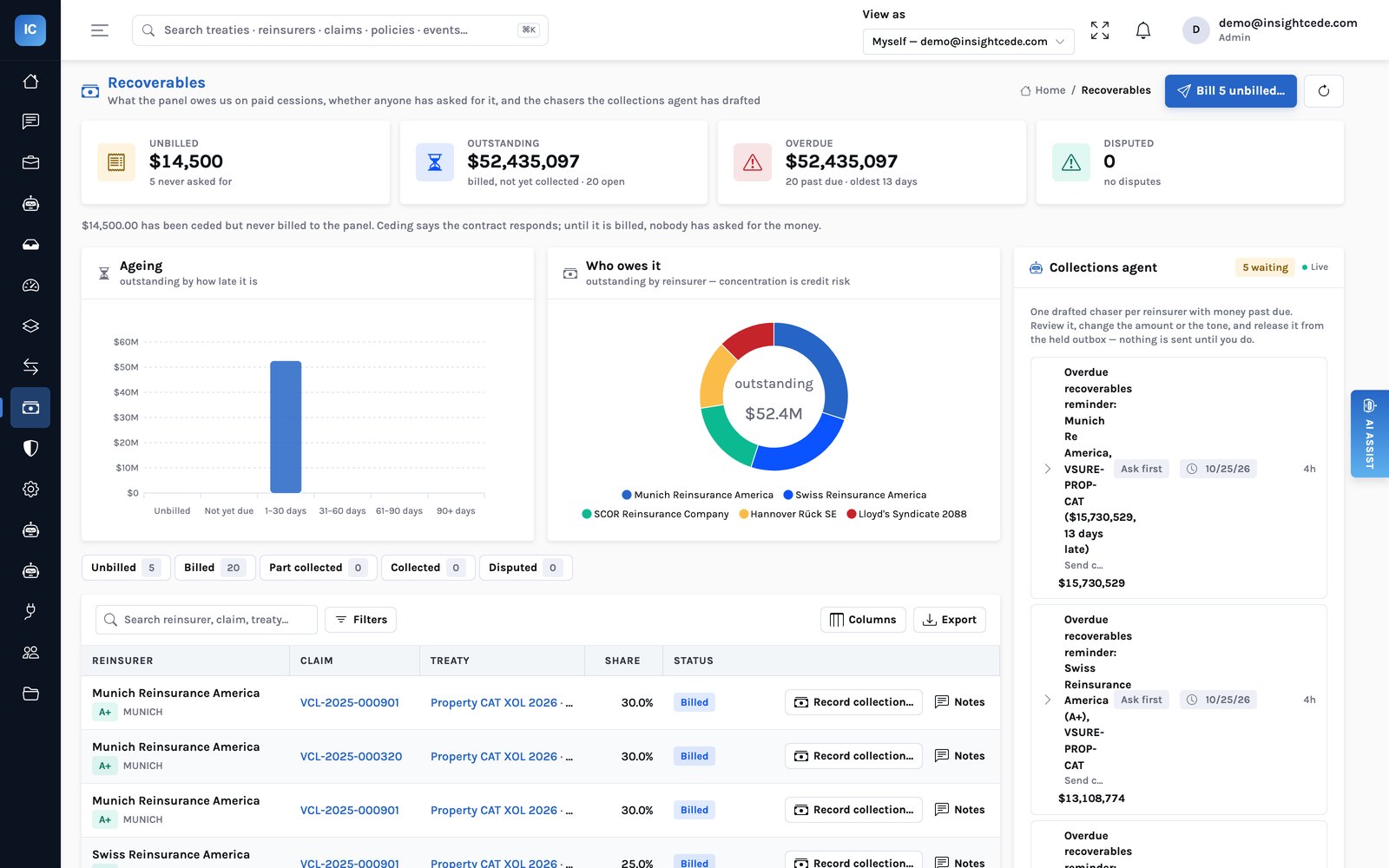
Some writes are deliberately not an agent's. They are the ones where the ledger has to agree with a bank statement or a signed contract, so a person makes them on the page, behind a confirmation — and the ones that move money need the manager role.
| Job | Where | Why it is a person's |
|---|---|---|
| Recording a collection | Recoverables: collect, with the amount (manager) | Money received is a fact from the bank, not from the ledger. It is the one write in the lifecycle no agent makes. |
| Billing unbilled recoverables | Recoverables: bill all, or one claim (manager) | It starts the settlement clock: the due date is set 30 days out |
| Booking excess layer premium | Programme: book layer premium (manager) | It is the agreed cost of cover, not a cession the engine can derive |
| Adding a reinsurer's contact | The reinsurer master, loaded with the programme (there is no edit screen yet) | An agent will not guess an address; the next run uses the one recorded |
| Supplying a counterparty statement | The reconciliation agent's run, through the API | The agent matches lines it is given; it does not read the reinsurer's file, and there is no screen for it yet |
The agents assemble; the analyst decides; the bank statement is still the bank statement.
A detail from the demo queue
Of the 26 open decisions in the demo programme, eleven are the statement agent's proposals to strike bordereaux for past periods, each with no amount at stake. Sorted by money, they sit at the bottom of the queue however long they have waited. That is the honest consequence of putting money first, and it is why each row also carries its deadline.
What it does not do
- Money first can starve small work. A decision with no amount — striking a period, a programme note — sorts last regardless of age. The deadline badge is the counterweight, and a decision still open fourteen days past its deadline expires so the agent prepares it again; neither moves it up the list.
- “In play” is not exposure. The queue's header adds up the amount on every open decision — $205,016,788 in the demo — and the same $15.7M owed by the lead appears in its chaser, the concentration proposal and the Schedule F draft. Read it as scale, not as a sum of money at risk.
- A missing contact is a phone call. When a reinsurer has no contact on file the notice goes to the others and names the gap. Reaching the one without a contact is the analyst's job until the master is updated.
- The reinsurer's account is typed in, not read. The reconciliation agent matches the lines it is given, by reference and amount within the tolerance ($1.00 by default). It does not open the reinsurer's spreadsheet or PDF.
- Tasks need their service. The tasks tab on My work needs insight-tasks mounted on the server; without it the page says so and the agents' queue carries the work.