The head of reinsurance spends the year in two modes. For most of it the job is watching: is the programme still the programme we bought, is anything written that it does not cover, is any reinsurer becoming a bigger share of what we are owed than we would choose. Then, ninety days before a treaty year expires, the job becomes the renewal, and the questions become harder to answer from a spreadsheet: what did this cover actually do for us, what did it cost, and who on the panel has earned their line.
The programme, as it stands
The Programme page lists every treaty by name and underwriting year, with its type, basis, status, the lines it covers, its terms, how much capacity is left, what it has been ceded and what it has paid back. Capacity is the point: a layer has a limit, and a limit again for each reinstatement, and beyond that the losses fall back to the carrier. The figure is derived from the cession ledger, never typed in.
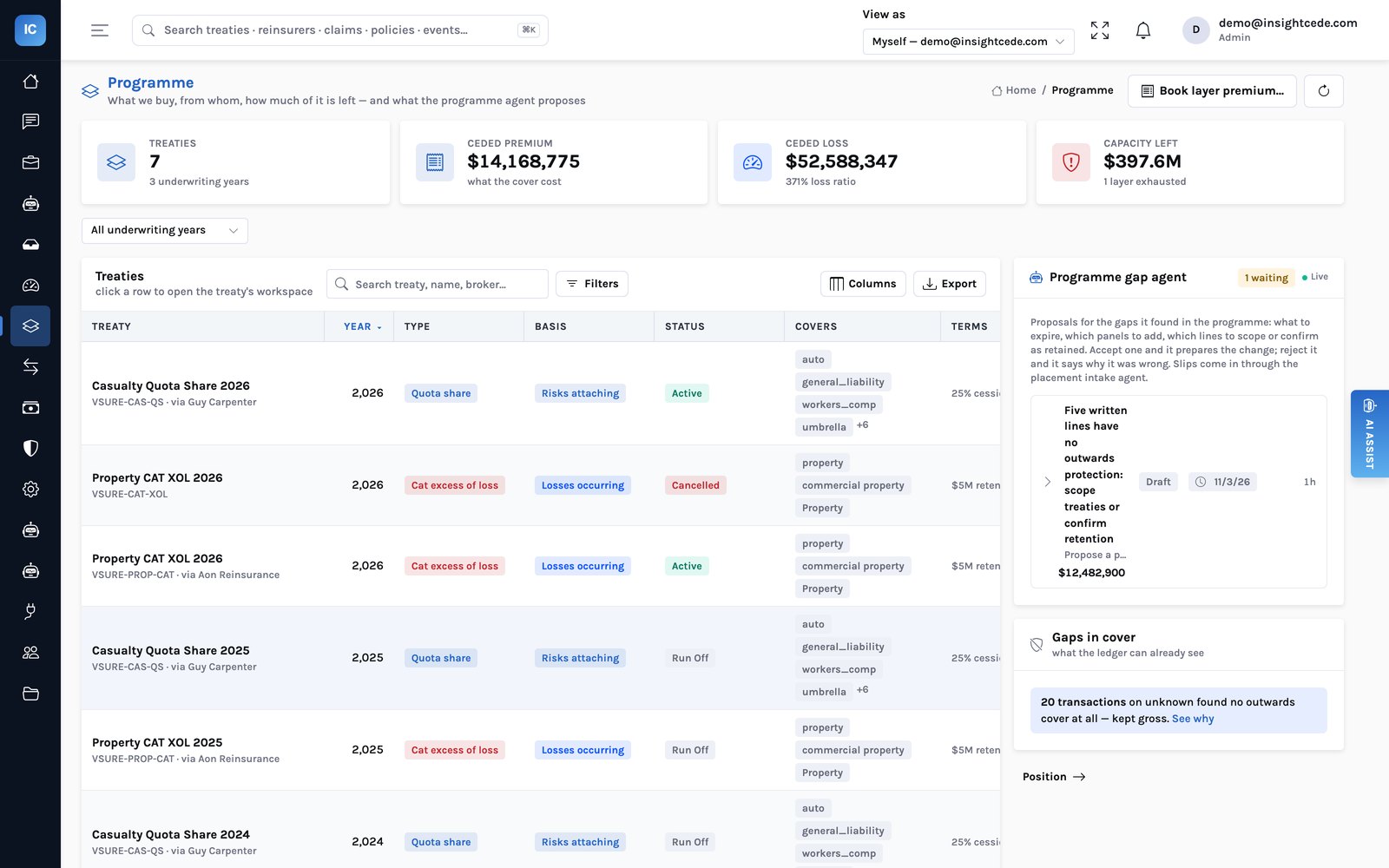
The programme gap agent reads the same programme on a schedule and proposes fixes for what it finds. Its checks are specific, and each one is a way carriers have lost money quietly.
| Gap | What it means | Why it matters |
|---|---|---|
| Unscoped treaty | No lines of business named, so it responds to everything | A casualty quota share takes a share of a property cat loss |
| Panel not 100% | Signed lines on a layer do not add up | Recoverables are raised on shares that do not exist, or not raised at all |
| No panel | A treaty year with nobody on it | Anything ceded to it cannot be billed or stated |
| Overlapping cover | Two treaties respond to the same loss at the same point | One loss is ceded twice |
| Expired but active | A year past its expiry still marked active | The programme misstates what is in force; a year in run-off should say so |
| Unprotected lines | Lines written with nothing above them | Gross exposure kept in full, often without a decision to keep it |
The programme in the demo ledger — a demo US property-casualty carrier, not a customer — is clean on the first five today. It was not when it arrived: the casualty quota share years and one cat year had no panel, one 2026 cat treaty duplicated another, and two expired years were still active. The sixth check still finds something.
pie showData
    title Premium written with no outwards protection (demo, $)
    "Medical malpractice" : 8444900
    "D and O" : 1625000
    "Cyber" : 1388000
    "General liability" : 750000
    "E and O" : 275000
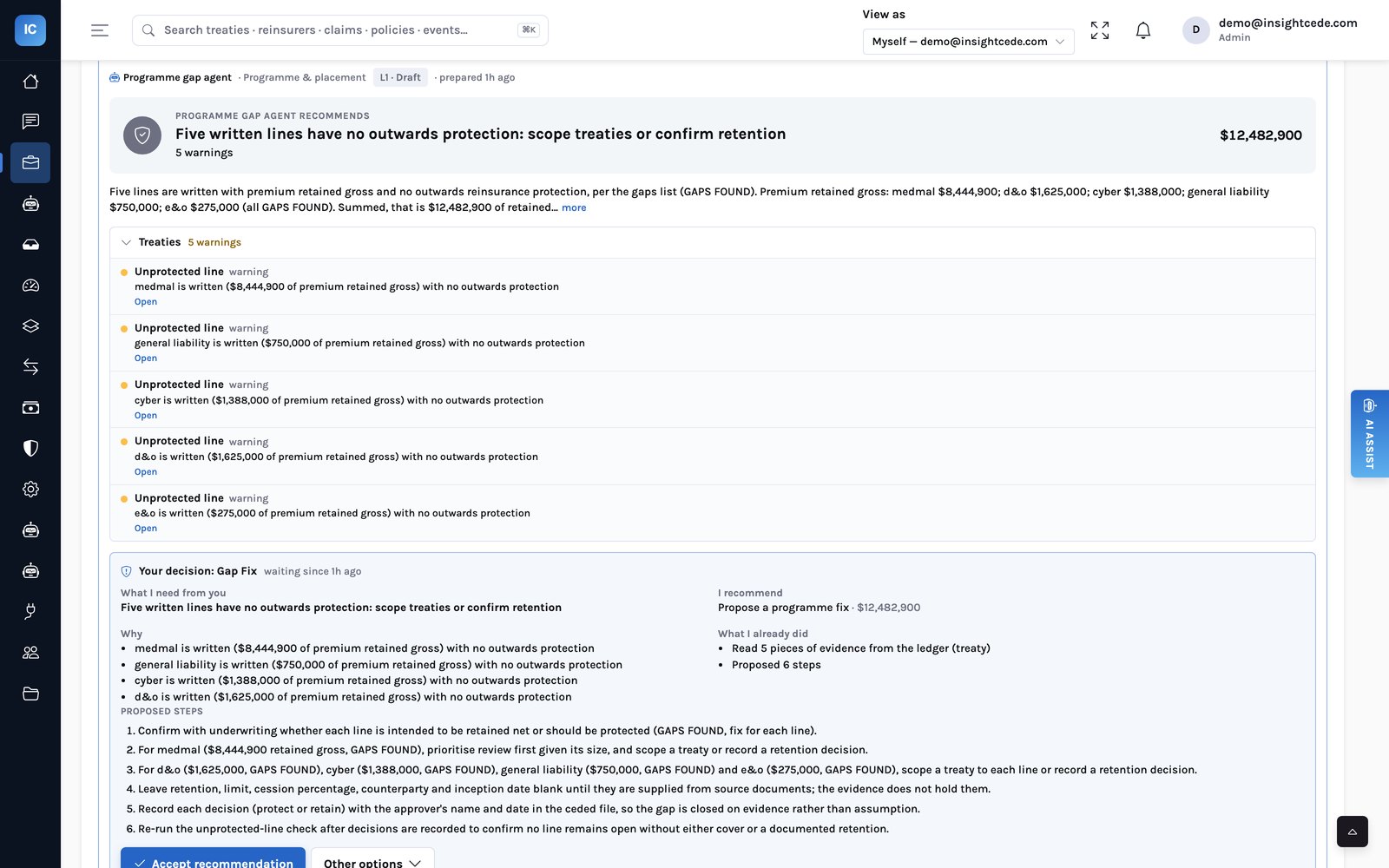
The evidence behind that proposal is not a survey of the book. It is the policy transactions the workbenches have already reported that found nothing above them. In the demo, 20 inbound events ceded nothing: ten bound policies recorded with the reason “no contract in force covers this policy”, and the rest claim movements below any attachment or outside any contract in force. The Position page carries the count as an alert. Some of those lines are meant to be kept net. The point is that keeping them becomes a recorded decision with a name and a date, rather than a fact nobody noticed.
Where the head of reinsurance sits on the dial
The programme agents — renewal prep, placement intake, programme gap — start at L1 and have nothing to send, so there is nothing for them to do alone. The head of reinsurance's part in the autonomy dial is elsewhere: as a manager who accepts or declines the promotions the evidence recommends for the agents that do reach the panel, and who can switch any agent back to drafts with a reason. Those changes are recorded like any other decision.
The renewal, ninety days out
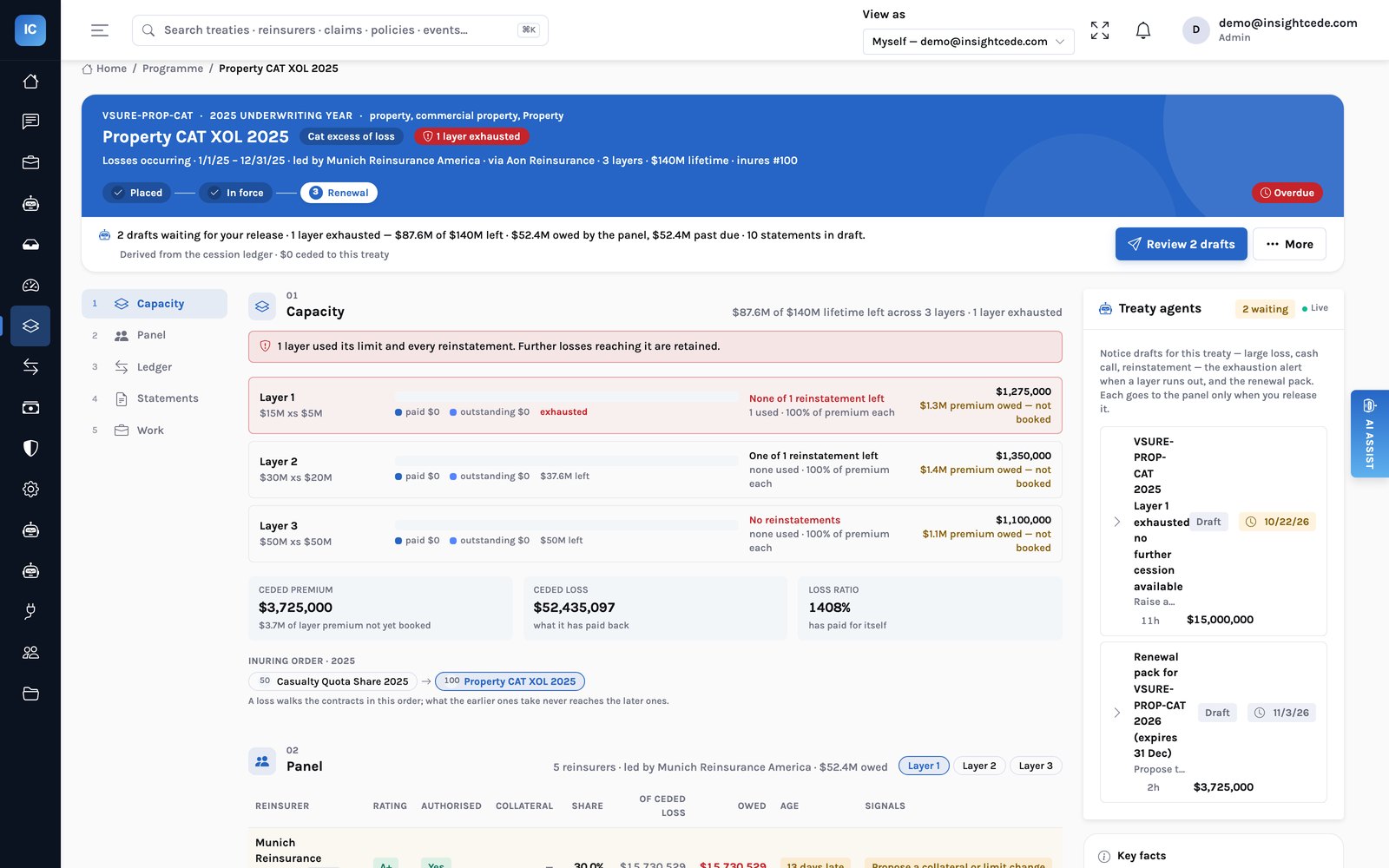
Ninety days before an active treaty year expires (the window is a setting), the renewal prep agent assembles a pack for it. Everything in the pack is a sum over the ledger, and the things the ledger never receives are left out rather than estimated.
| In the renewal pack | Never in it |
|---|---|
| Experience by underwriting year: ceded premium, commission, layer premium, reinstatement premium, ceded loss, cost of cover, loss ratio on that cost | Exposure: limits profiles, aggregates, cat model output. Cede never receives them |
| Each layer: limit, attachment, lifetime capacity, eroded, reinstatements and used, rate on line, premium | Market pricing, or what the panel will quote |
| The panel with signed lines, ratings and contacts | A view on whether to renew a reinsurer |
| The five largest claims ceded to the treaty | Claims that have not been reported to Cede |
The loss ratio in the pack is ceded loss over the cost of cover, which includes reinstatement premium. On the demo's 2025 property cat year that is $52,435,097 against $3,725,000 of layer premium plus $724,929.26 of reinstatement premium — about 1,178%. The Programme page shows the ceded loss ratio on premium alone, about 1,408%. Both are right; they answer different questions, and the pack says which one it is using.
gantt
    dateFormat  YYYY-MM-DD
    axisFormat  %b %d
    todayMarker off
    section Cede prepares
    Renewal pack drafted (90 days out)    :done, a1, 2026-10-03, 3d
    Head of reinsurance reviews           :done, a2, 2026-10-06, 10d
    section Outside Cede
    Exposure data and submission          :a3, 2026-10-16, 21d
    Market quotes and firm order          :a4, 2026-11-06, 35d
    section Back in Cede
    Slip text to placement intake         :a5, 2026-12-11, 5d
    Programme loaded for 1 January        :crit, a6, 2026-12-16, 16d
The panel, and who you rely on
The Reinsurers page is the panel by name: rating, whether the reinsurer is authorised, collateral held, which treaties it sits on and where it leads, what it owes, its share of everything outstanding, and how much of that is overdue or disputed.
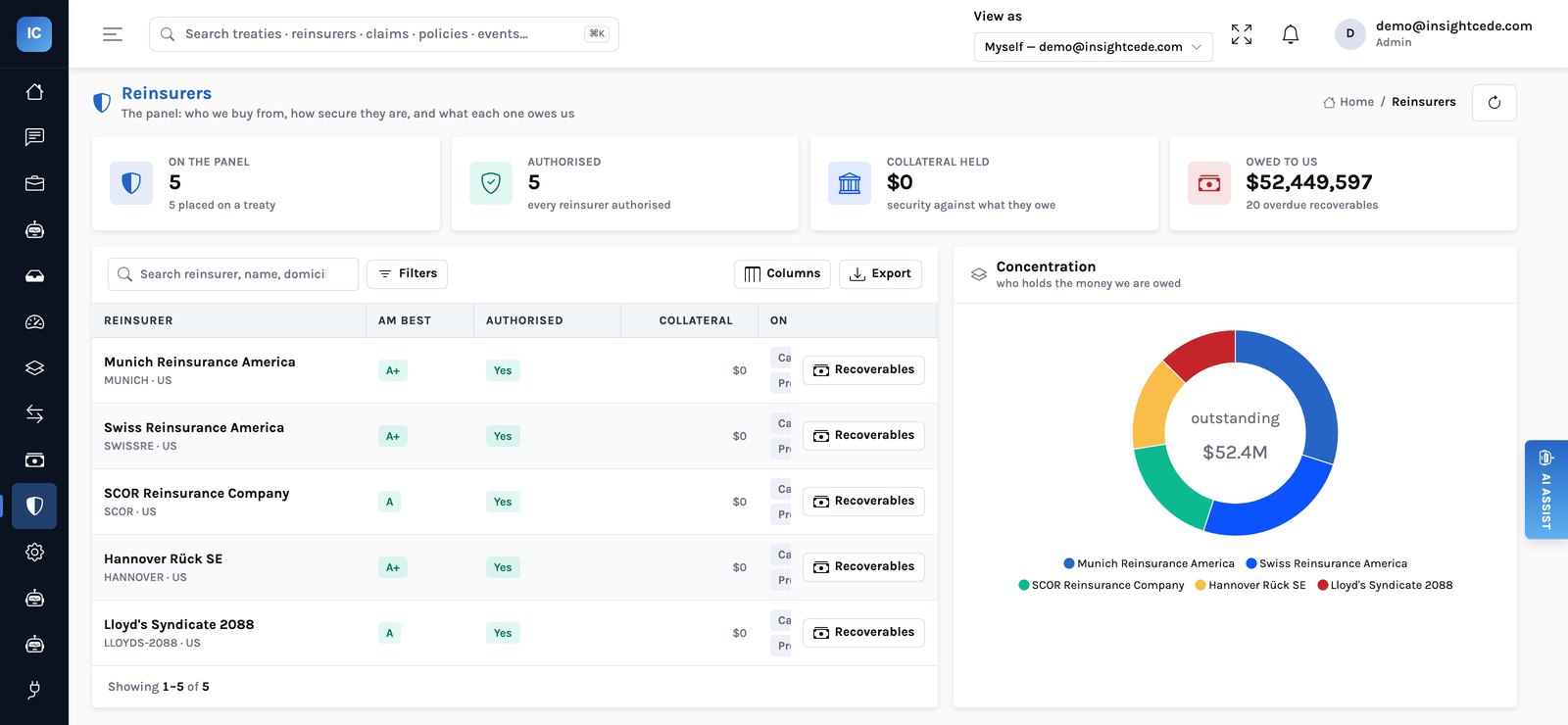
The counterparty watch agent reads the same data against a concentration limit (25% of what the panel owes, by default) and the reinsurer's standing, with news signals from InsightPulse cited rather than turned into facts. In the demo it has an open proposal: Munich Reinsurance America holds 30% of the panel's $52,435,097 balance, above the limit. Its proposed steps end with the manager choosing the remedy and obtaining a second rating the evidence does not hold.
The renewal pack knows what the cover did. It does not know what the cover will cost. Both statements are on the page.
What it does not do
- It does not edit the programme. There is no screen or route to enter or change a treaty, a layer or a panel line in Cede today. The programme is loaded from the carrier's book of record by a script. Accepting a placement proposal or a gap fix records agreement; a person makes the change at the source and the programme is reloaded.
- The slip goes in as text. The placement intake agent reads the text it is given, or a document's extracted text where the documents service holds it. There is no upload screen for a slip yet; the run is started through the API.
- No exposure, no pricing. The renewal pack never contains limits profiles, aggregates or market prices, because Cede never receives them.
- Stale proposals wait. One of the three renewal packs in the demo queue is for a 2026 cat treaty that has since been retired as a duplicate. It stays until someone rejects it or it expires.