The annual statement is due on the first of March, and Schedule F is the part that takes longest for the least judgement. The statutory reporting lead pulls the ceded ledger into one workbook, the panel master into another, gets the collateral schedule from treasury, and types NAIC company codes in by hand from last year’s filing. Then the recoverables are re-aged as at 31 December, because the ledger’s ageing is as at whenever someone ran it. Every number in it already exists somewhere. The work is lining them up.
InsightCede lines them up every day, so that the work in February is checking and completing a draft rather than building one. This post is precise about which half that is.
What Schedule F asks for, and what Cede can answer
Schedule F is the reinsurance schedule of a US property and casualty annual statement. Part 1 reports assumed reinsurance — business the carrier takes in — and Cede holds none: it is the outwards ledger. Part 3 reports ceded reinsurance, reinsurer by reinsurer: premium ceded, what is recoverable on paid and unpaid losses, how much of it is overdue and by how long, what is in dispute, the collateral held, and whether each reinsurer is authorised in the carrier’s domicile. The provision for reinsurance — the charge for credit taken on reinsurance that is unauthorised, slow-paying or uncollateralised — is worked out from those columns. That ceded data is what the Schedule F agent drafts.
flowchart LR
    subgraph L["The ledger"]
        P["Premium cessions
in the year"]
        C["Loss cessions in the year
paid · outstanding"]
        S["Panel shares
per treaty"]
        R["Recoverables
as at the run"]
        M["Reinsurer master
authorised · collateral
domicile · NAIC code"]
    end
    P --> D["Per reinsurer
premium · losses ·
recoverables by bucket ·
disputed · collateral"]
    C --> D
    S --> D
    R --> D
    M --> D
    M --> X["Missing
NAIC code · domicile
collateral short of balance"]
    D --> Q["Draft in the queue, L1"]
    X --> Q
    Q --> F["Statutory team
completes and files"]
How the draft is built
Every twenty-four hours, in the credit step, the agent drafts the parts for the current calendar year. For each reinsurer in the master it carries the legal name, domicile, whether it is authorised, the collateral held and its NAIC identifier if one has been recorded. It then works out four sets of figures:
- Ceded premium — the premium cessions booked to the year’s accounting periods, treaty by treaty, times the reinsurer’s share of each treaty.
- Ceded losses — the loss cessions booked to the year, split into paid and outstanding, the same way.
- Recoverables by age — what each reinsurer owes today, bucketed by days past due: current, 1–90, 91–120 and over 120.
- Disputed — the part of those recoverables marked in dispute.
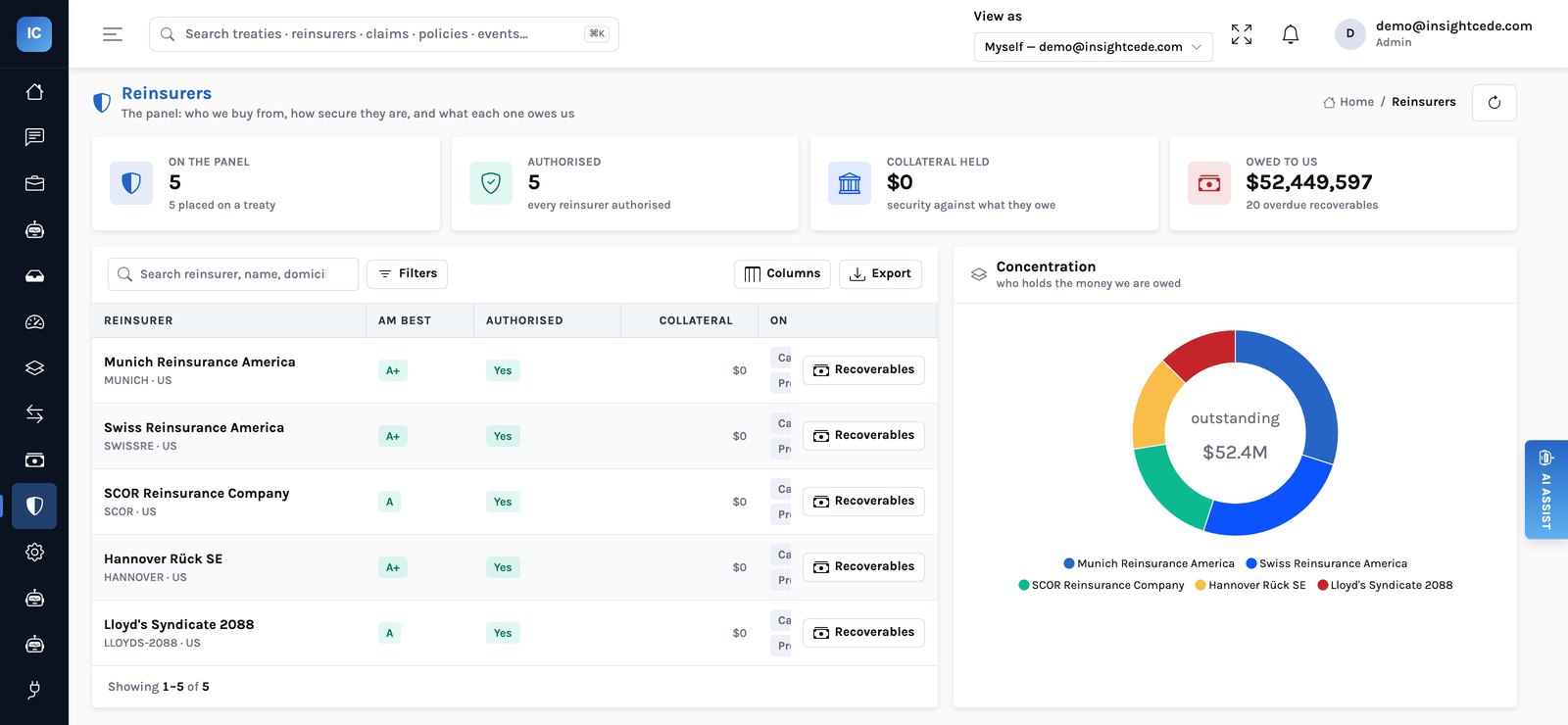
Then it lists what is missing, and this list is the most useful thing on the record: a reinsurer with no NAIC identifier on file, one with no domicile, and an unauthorised reinsurer whose collateral is less than what it owes — with the uncollateralised amount. A missing identifier is a flag, never a lookup: the agent will not guess a company code. If a model is reachable it writes the explanation; the figures and the missing list are computed before it is asked, and its catalogue entry forbids it to invent an identifier.
Why a draft every day, not once a year
A Schedule F built in February finds its problems in February. A draft refreshed every day finds them the week they appear: the day a large loss is billed to an unauthorised reinsurer whose collateral no longer covers it, the day a reinsurer joins the panel with no company code on file, the month an old balance slips past 120 days. Each of those is a conversation with treasury, the broker or the reinsurer that is much easier in August than in the last week of February. The draft also never touches the figures it reads: if the ledger changes, the next run supersedes yesterday’s draft with today’s, and the queue holds one draft per statement year.
Use case details
| Schedule F | |
|---|---|
| Trigger | Scheduled, every 24 hours (the credit step), for the current calendar year |
| Actor(s) | Statutory reporting lead; CFO for the provision and any judgement on collateral; treasury for collateral evidence |
| Agent | schedule_f_agent, action draft_schedule_f |
| Grounded in | cede_premium_cession and cede_loss_cession by period, cede_participation (panel shares), cede_recoverable (ageing, disputed), cede_reinsurer (authorised, collateral, domicile, NAIC code) |
| Prepares | The per-reinsurer ceded figures and a list of what must be supplied before filing |
| Checkpoint & default level | schedule_f_review at L1 Draft |
| What a person decides | Whether each figure is right as at the statement date, how to complete the missing items, the provision for reinsurance, and what is filed |
| What is recorded | The run, the draft with every reinsurer’s figures and the missing list as evidence, the answer as feedback |
The demo programme’s draft
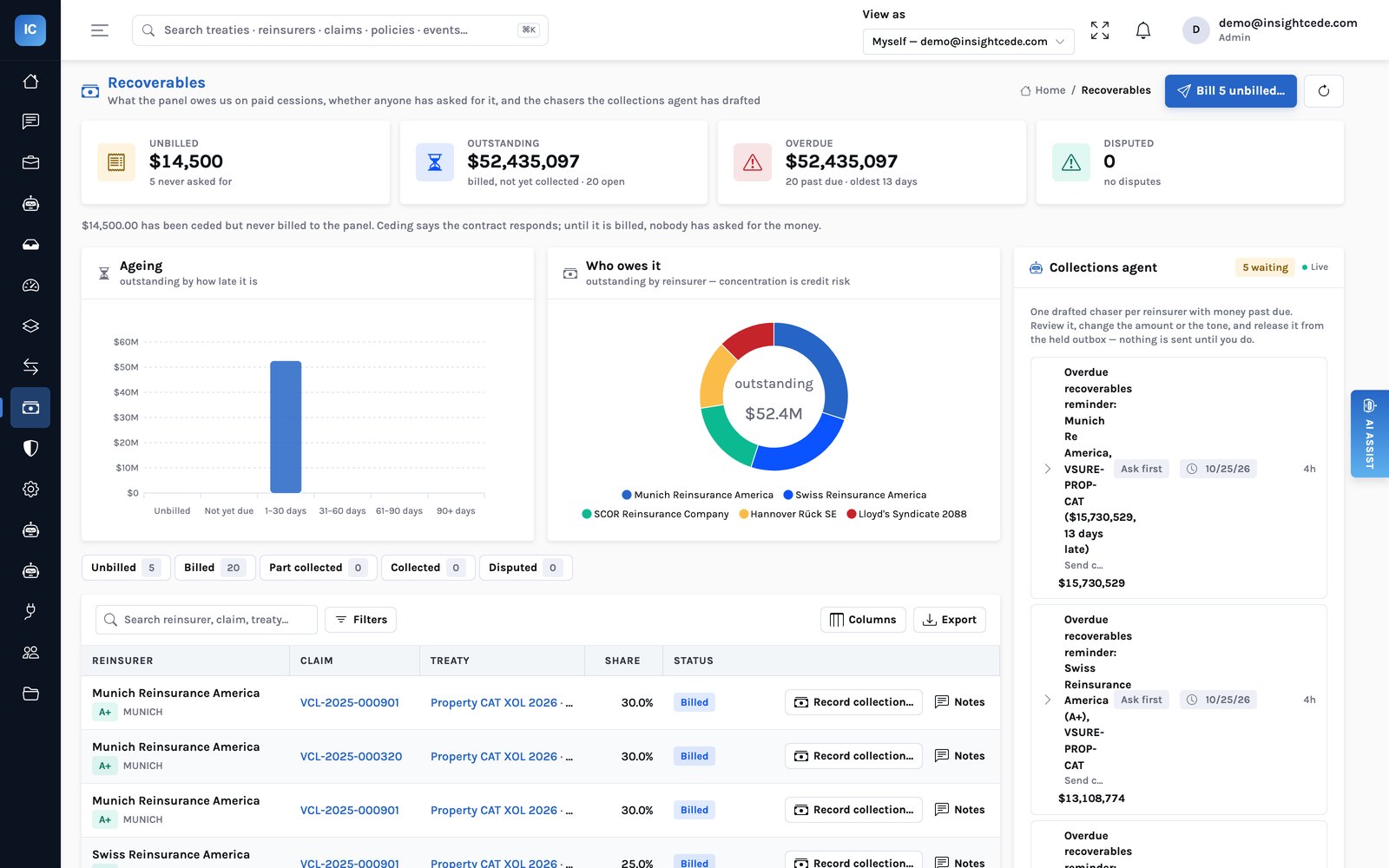
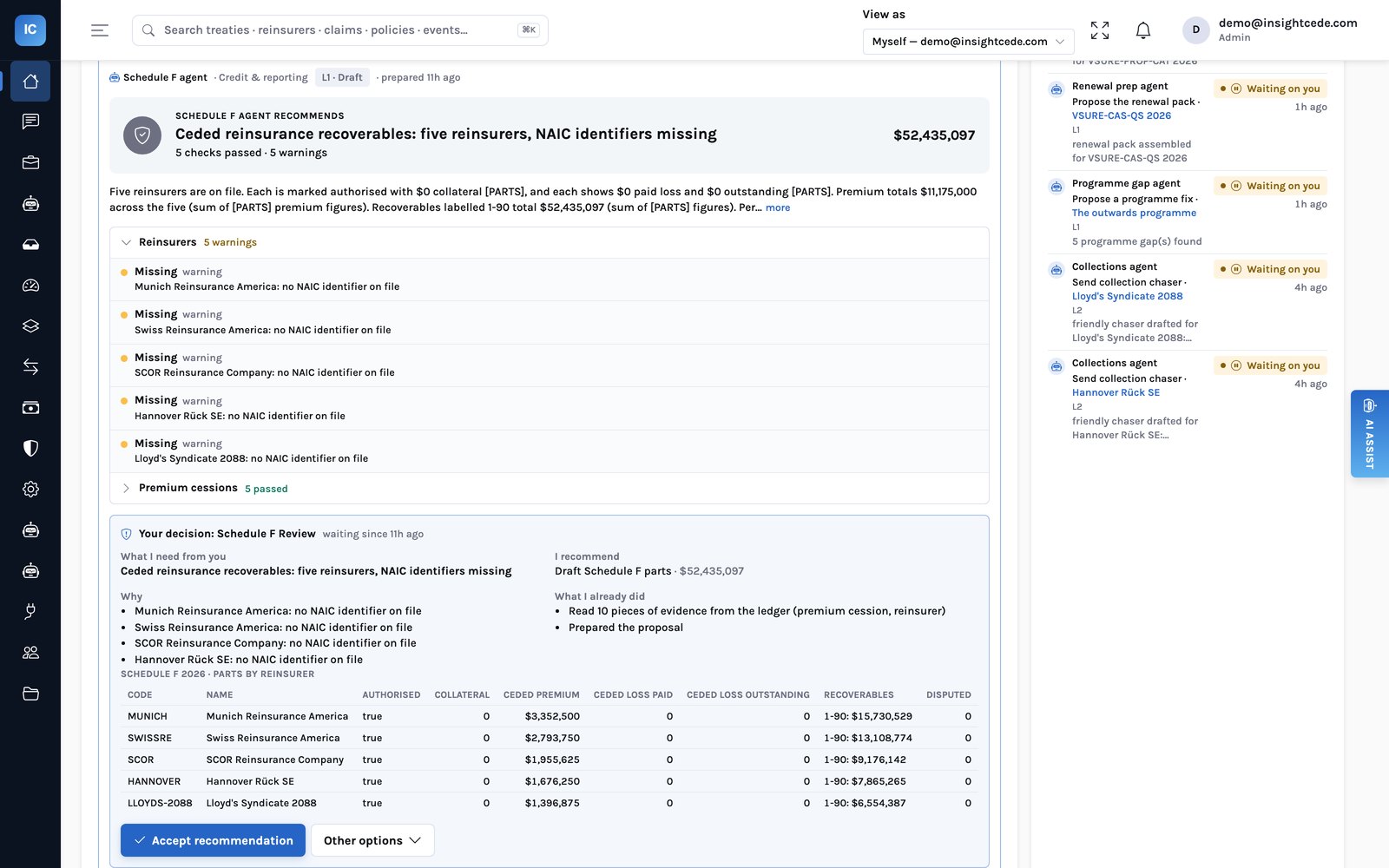
The demo ledger’s Schedule F 2026 draft is the largest item in its queue: five reinsurers, $52,435,097 of recoverables, five items missing. Every recoverable fell due on 7 October and is thirteen days late, so all of it sits in the 1–90 bucket. Every reinsurer is marked authorised with no collateral held, so nothing is flagged as uncollateralised. None has an NAIC identifier on file, which is the whole missing list.
| Reinsurer (demo) | Recoverables, 1–90 days | Authorised | Collateral | Missing |
|---|---|---|---|---|
| 30% lead line | $15,730,529 | Yes | $0 | NAIC identifier |
| 25% line | $13,108,774 | Yes | $0 | NAIC identifier |
| 17.5% line | $9,176,142 | Yes | $0 | NAIC identifier |
| 15% line | $7,865,265 | Yes | $0 | NAIC identifier |
| 12.5% line | $6,554,387 | Yes | $0 | NAIC identifier |
Two things in that draft are worth reading closely, and the model flagged one of them itself. Its explanation says the evidence does not explain the “1–90” label, so it reports the figure as given and asks the reviewer to confirm its meaning. It is right to ask: the statutory ageing splits the first ninety days into 1–29 and 30–90, and the draft does not. The other is the loss columns, which read $0 for every reinsurer. The two catastrophe losses behind the $52.4M were booked to 2025 accounting periods; the 2026 draft counts 2026 periods for premium and losses, while recoverables are whatever is owed today. Both readings are correct; they are not the same as-at date, and the filing needs one.
Ravi did not assemble anything. He completed three items the ledger could not know, re-cut one column, and spent the time he saved on the $300,000 over 120 days, which is the figure the regulator will read first.
What it does not do
- It is not the schedule. It drafts the ceded figures by reinsurer. It does not produce the statutory form, compute the provision for reinsurance, or file anything; accepting the draft records that it was reviewed.
- It does not touch Part 1. Cede is the outwards ledger and holds no assumed business.
- Its ageing is coarser than the statement’s. One 1–90 bucket where the schedule has 1–29 and 30–90. Recoverables are aged as at the day the agent runs.
- It mixes a year with a day. Premium and losses are the statement year’s accounting periods; recoverables are as owed on the run date; the scheduled draft is always for the current calendar year. Read the year-end draft from the last run of the year.
- Unpaid losses are case reserves only. Outstanding ceded losses come from the claim positions the claims system sends. Ceded IBNR is an actuarial figure Cede never receives.
- Authorised is a yes or no. Certified and reciprocal-jurisdiction reinsurers, and their reduced collateral requirements, are not modelled.
- A known defect in this build. On a treaty with several layers, the draft counts a reinsurer’s share once per layer when it spreads premium and losses. In the demo that makes the premium column three times what was booked: $11,175,000 across the panel against $3,725,000 of 2026 layer premium on the three-layer cat treaty. Check ceded premium against the bordereaux until it is fixed.
- Two columns are off screen. The decision’s parts table hides domicile and NAIC code; where they are missing, the missing list says so.
Why a missing identifier stays missing
An NAIC company code that is plausible and wrong attaches one reinsurer’s recoverables to another company in the regulator’s records. A blank is visible on review; a guess is not. So the agent flags it, and the person who has the prior filing fills it in.
If your Schedule F still starts with a blank workbook in January, talk to us about running the draft over a demo ledger built from last year’s panel and recoverables.